TheYavue Official Website › Blog › AREDS2
Lutein and zeaxanthin: what AREDS2 actually tested, and what a blend can hold
Two numbers sit behind this entire category: 10 mg of lutein and 2 mg of zeaxanthin a day. They come from one trial, they are the reason most eye supplements name those two ingredients on the front of the bottle, and most of those bottles will not tell you how much of either they contain.
The trial these two numbers come from
AREDS2 was run by the National Eye Institute and reported in JAMA in 2013. It randomised more than four thousand people at risk of progression to advanced age-related macular degeneration, and it ran for five years.
The carotenoid arm gave 10 mg of lutein with 2 mg of zeaxanthin daily. Those exact figures are what the protocol used and they are why every serious eye supplement quotes them.
A secondary analysis covered the comparisons the primary paper could not, and a later report followed the same cohort out to ten years, which makes this one of the longest-followed nutritional interventions in ophthalmology.
It is worth being clear about the population. Everybody in AREDS2 already had macular degeneration and was under specialist care. The result is about slowing progression in a diagnosed group. It is not a result about healthy eyes, and no supplement label in this category is entitled to imply that it is.
Why AREDS2 happened at all
The first trial, AREDS, reported in 2001. Its formula was vitamin C at 500 mg, vitamin E at 400 IU, beta-carotene at 15 mg, and zinc at 80 mg with 2 mg of copper.
Two problems with that formula drove the second trial.
The first was the beta-carotene. Supplemental beta-carotene had been associated with raised cancer risk in smokers, a finding later pooled in a 2023 meta-analysis of randomised trials. A formula for older adults that a former smoker could not safely take is a formula with a serious practical limit.
The second was the zinc. Eighty milligrams a day is twice the modern adult upper intake level, and the question of whether that much was necessary had never been tested.
So AREDS2 replaced the beta-carotene with lutein and zeaxanthin and tested a lower zinc arm. That substitution is the single event that created the modern eye supplement shelf.
What it found, and what it did not
The carotenoid substitution worked as a replacement: lutein and zeaxanthin performed at least as well as the beta-carotene they replaced, without the cancer signal. The lower zinc arm progressed no differently from the 80 mg arm.
What AREDS2 did not find is more interesting and much less quoted. Adding lutein and zeaxanthin to the original formula did not produce a further reduction in progression in the primary analysis. The benefit showed up in the substitution and in secondary analyses rather than as a headline effect.
Anybody quoting AREDS2 on a supplement label is quoting a trial whose main finding was that two carotenoids are a safe and effective replacement for one that had a problem. That is a genuine result and it is narrower than most labels imply.
| AREDS (2001) | AREDS2 (2013) | |
|---|---|---|
| Vitamin C | 500 mg | 500 mg |
| Vitamin E | 400 IU | 400 IU |
| Beta-carotene | 15 mg | Removed |
| Lutein | None | 10 mg |
| Zeaxanthin | None | 2 mg |
| Zinc | 80 mg as zinc oxide | 80 mg, with a 25 mg arm tested |
| Copper | 2 mg as cupric oxide | 2 mg |
| Who it enrolled | People with age-related macular degeneration | The same population |
Doses as printed in the published trial protocols.
- AREDS2 randomised 10 mg lutein and 2 mg zeaxanthin daily, for five years.
- Everybody enrolled already had macular degeneration, under specialist care.
- The carotenoids replaced beta-carotene; they were not simply added.
- A 25 mg zinc arm performed the same as 80 mg.
- A ten-year follow-up reported on the same cohort.
The measurement that made a category
Clinical outcomes take five years. Something faster was needed for a category to exist, and macular pigment optical density is it.
The macular pigment can be measured through the closed eye. It is a real number, it responds to supplementation, and a 2024 network meta-analysis pooled the randomised trials that measured it and found carotenoid arms raise it.
That is a genuine, repeatable biological effect and it is the strongest thing this category has. It is also a biomarker. A rise in pigment density is not the same claim as a change in what somebody sees, and the trials that looked at what people see are the five-year ones.
Keeping those two apart is most of what it takes to read this shelf honestly. A product can raise a measurement and still be sold on a promise nobody tested.
Order TheYavue on the official website
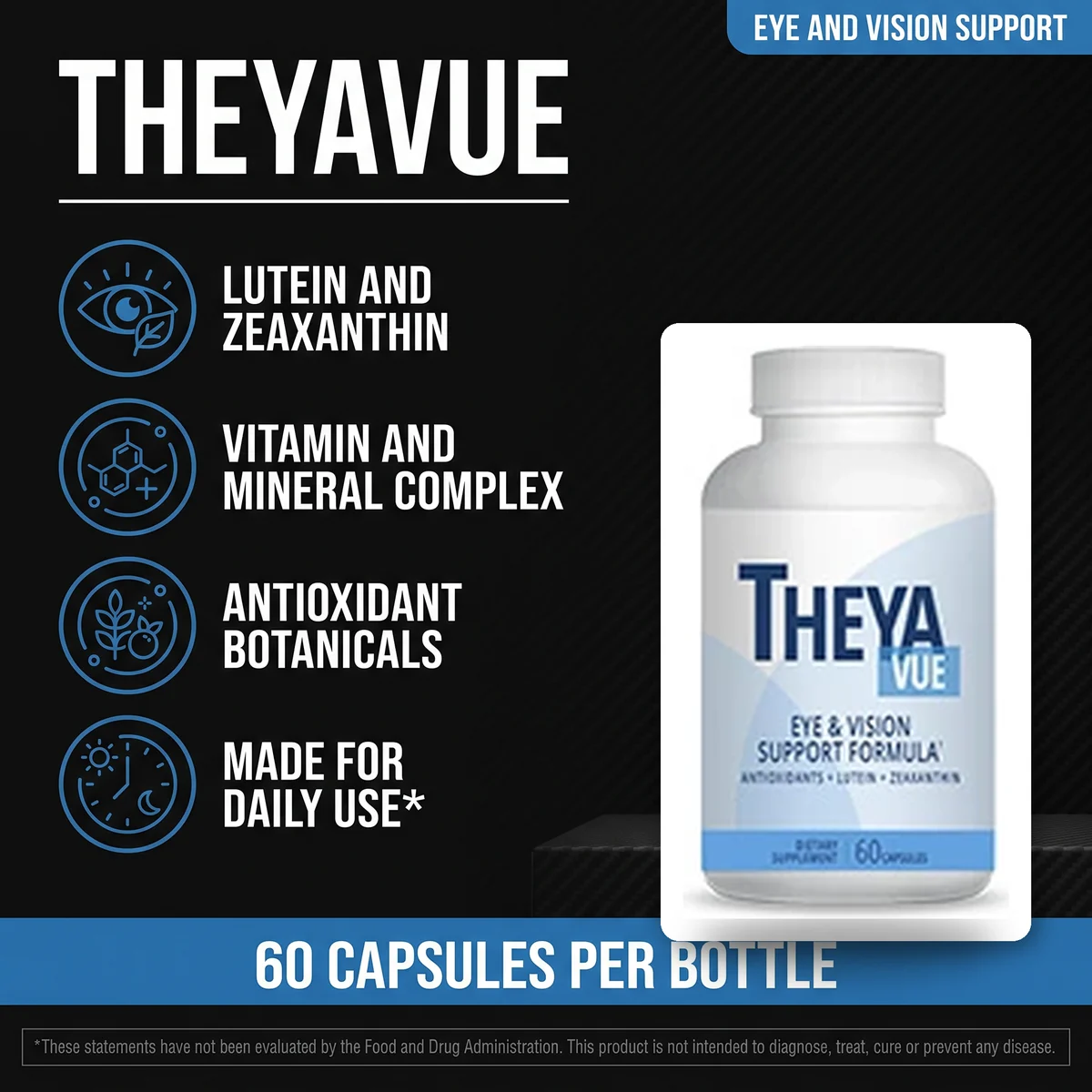
Lutein first and zeaxanthin fifth in a 240.5 mg blend of ten, with the four AREDS nutrients all present on the panel. Sixty days to decide, opened bottles included.
One bottle $59 · six bottles $234 · 60-day money-back guarantee
Order TheYavue On The Official WebsiteOne capsule twice a day · 60 a bottle · lot THE-26/TH-4593
What a blend total can and cannot hold
Federal labelling rules permit a proprietary blend to declare one total weight and list its contents in descending order of predominance, with no individual amounts. Most of this category uses that provision, and it is where the AREDS2 numbers stop being checkable.
TheYavue is a worked example. Its blend is 240.5 mg a capsule and 481 mg a day, across ten ingredients. Lutein is listed first and zeaxanthin fifth.
What that allows: the AREDS2 pair is 12 mg between them, which fits inside 481 mg many times over. There is nothing implausible about this bottle containing the trial amounts.
What it prevents: confirming it. The split could be anything consistent with the ordering. Lutein could be 200 mg or it could be 30. Both are legal, both are consistent with the label, and no amount of reading narrows it.
The ordering is not nothing, though, and it is worth using. Zeaxanthin being fifth means three botanicals weigh more than it does, and zeaxanthin is the pigment concentrated at the very centre of the macula. That is a real piece of information about how the formula was built.
| What a label does | What you can conclude | Example |
|---|---|---|
| Prints lutein and zeaxanthin with amounts | Everything. Compare directly with 10 mg and 2 mg | An AREDS2-formula product |
| Puts them in a blend and lists them first and second | That they outweigh the rest of the blend. Nothing about a dose | — |
| Puts them in a blend and lists them first and fifth | That three other things weigh more than the zeaxanthin | TheYavue |
| Names them on the front and omits them from the panel | Almost nothing. The weakest disclosure in the category | — |
Every row is a legal way to label a product. They differ entirely in what a buyer can check.
How to read a label against this trial
Four questions, in order, and all four are answerable in a shop.
- Does the panel print an amount for lutein? If yes, compare it with 10 mg and you are done.
- Does it print one for zeaxanthin? Compare with 2 mg.
- If both are inside a blend, where in the order do they sit? First and second is a carotenoid formula. First and fifth is a formula with botanicals in front of one of them.
- Is the zinc between 25 and 40 mg, with about 2 mg of copper beside it? That pairing is the clearest sign somebody read the trial rather than a competitor’s label.
One more thing about that fourth question, because it is the check most people skip and the one that separates a formula built from the literature from a formula built from a competitor’s bottle.
Zinc competes with copper for absorption. AREDS carried 2 mg of copper alongside its 80 mg of zinc specifically to protect copper status over years of daily use, and a formula that copies the zinc and omits the copper has copied the visible half of the design. It is a row that costs almost nothing to include and that nobody adds by accident, which is exactly why it is such a reliable signal about who wrote a panel.
The same logic applies in reverse to the carotenoid ratio. AREDS2 used five parts lutein to one part zeaxanthin, so a blend listing zeaxanthin immediately after lutein is at least consistent with that shape. A blend that puts three other things between them has made a different decision, and a reader is entitled to notice it even without a figure.
- 10 mg lutein and 2 mg zeaxanthin, daily, for five years.
- In people who already had macular degeneration, under specialist care.
- As a replacement for beta-carotene, not as an addition to the formula.
- With 2 mg of copper beside the zinc, deliberately.
- A raised pigment measurement is a biomarker, not a promise about sight.
Where TheYavue lands on those four: the first two are unanswerable, the third says lutein leads and zeaxanthin sits fifth, and the fourth is the best thing on the panel at 32 mg of zinc with 2 mg of copper.
Two of four, with the two failures on the questions a carotenoid buyer probably came for. The full reading is on the ingredients page, and the blend arithmetic has an article of its own.
New floaters, flashes of light, a shadow across part of your vision, sudden blurring or pain in the eye need an examination within days. No supplement and no article is a reason to wait. If you take prescription medicine, take the bottle to a pharmacist: a Supplement Facts panel reads in seconds and a brand name does not.
References
- Age-Related Eye Disease Study 2 (AREDS2) Research Group. Lutein + zeaxanthin and omega-3 fatty acids for age-related macular degeneration: the Age-Related Eye Disease Study 2 (AREDS2) randomized clinical trial. JAMA. 2013;309(19):2005-15. PMID 23644932. https://pubmed.ncbi.nlm.nih.gov/23644932/
- Chew EY, Clemons TE, SanGiovanni JP, et al. Secondary analyses of the effects of lutein/zeaxanthin on age-related macular degeneration progression: AREDS2 report No. 3. JAMA Ophthalmol. 2014;132(2):142-9. PMID 24310343. https://pubmed.ncbi.nlm.nih.gov/24310343/
- Chew EY, Clemons TE, Agrón E, et al. Long-term outcomes of adding lutein/zeaxanthin and omega-3 fatty acids to the AREDS supplements on age-related macular degeneration progression: AREDS2 report 28. JAMA Ophthalmol. 2022;140(7):692-698. PMID 35653117. https://pubmed.ncbi.nlm.nih.gov/35653117/
- Hu W, Seah V, Huang V, et al. Effect of antioxidant supplementation on macular pigment optical density and visual functions: a systematic review and network meta-analysis of randomized controlled trials. Adv Nutr. 2024;15(5):100216. PMID 38582248. https://pubmed.ncbi.nlm.nih.gov/38582248/
- Age-Related Eye Disease Study Research Group. A randomized, placebo-controlled, clinical trial of high-dose supplementation with vitamins C and E, beta carotene, and zinc for age-related macular degeneration and vision loss: AREDS report no. 8. Arch Ophthalmol. 2001;119(10):1417-36. PMID 11594942. https://pubmed.ncbi.nlm.nih.gov/11594942/
- Zhang Y, Yang J, Na X, et al. Association between beta-carotene supplementation and risk of cancer: a meta-analysis of randomized controlled trials. Nutr Rev. 2023;81(9):1118-1130. PMID 36715090. https://pubmed.ncbi.nlm.nih.gov/36715090/
- 21 CFR 101.36 — Nutrition labeling of dietary supplements. U.S. Food and Drug Administration, Code of Federal Regulations. https://www.ecfr.gov/current/title-21/chapter-I/subchapter-B/part-101/subpart-A/section-101.36