TheYavue Official Website › Blog › The blend
A 240.5 mg blend and a 240 mg trial: the arithmetic of a proprietary blend
The TheYavue proprietary blend weighs 240.5 mg a capsule and holds ten ingredients. One of those ten, bilberry extract, has a published trial that used 240 mg a day on its own. The two figures are the same to within half a milligram, and that coincidence is the clearest way to show what a blend costs a reader.
What a proprietary blend is
The federal labelling regulation allows a dietary supplement to declare a group of ingredients as a blend: one total weight, contents listed in descending order of predominance, no individual amounts.
It is legal, it is common, and the stated justification is formula confidentiality. For a genuinely novel combination that argument carries some weight. In a category where every ingredient is public and the reference doses are printed in a trial protocol, it carries less.
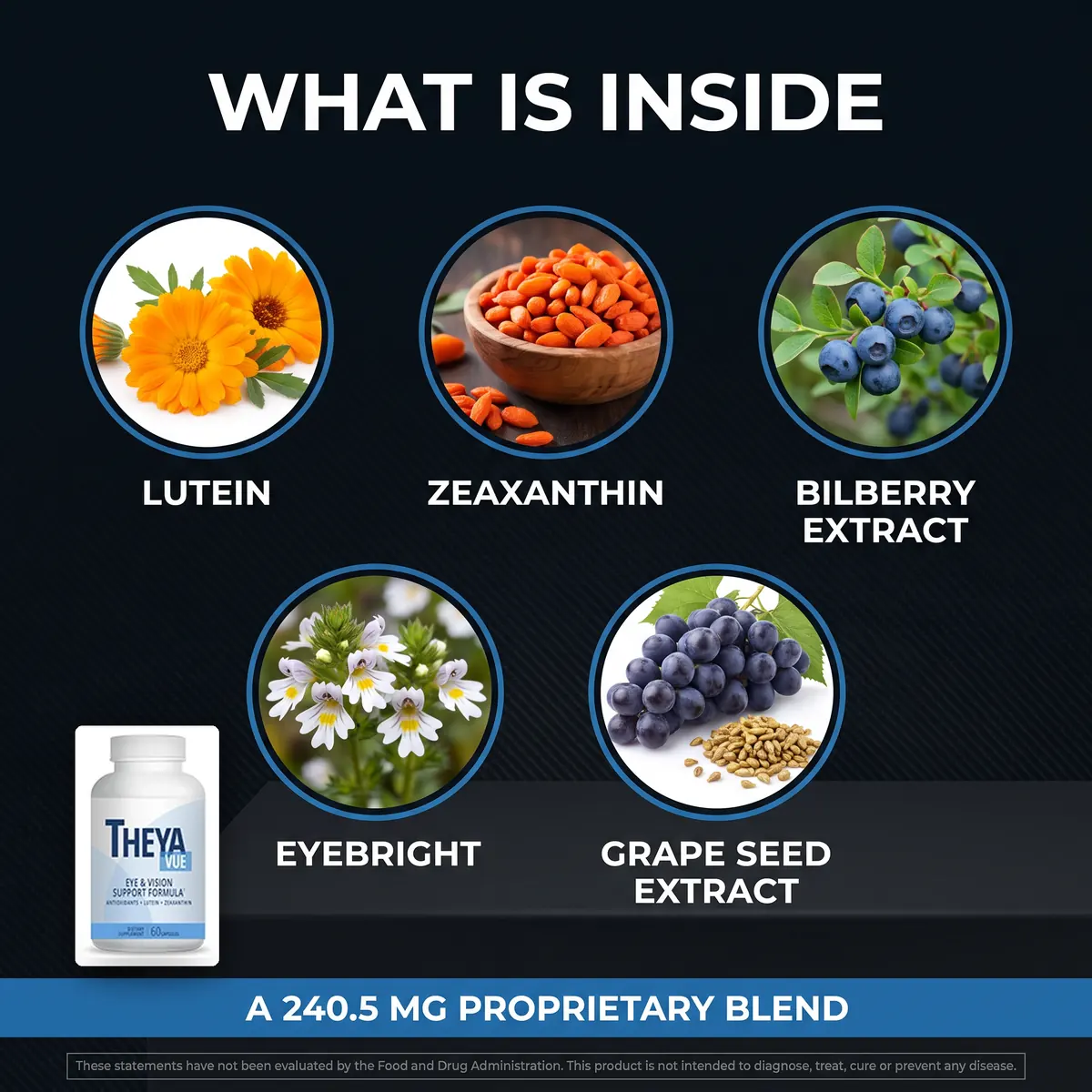
TheYavue declares one. The line reads Proprietary Blend 240.5 mg with a dagger rather than a percentage, and beneath it ten names in order: lutein, bilberry extract, alpha lipoic acid, eyebright, zeaxanthin, quercetin, rutin, L-taurine, grape seed extract, lycopene.
At the label’s two-capsule direction, that is 481 mg a day shared ten ways.
The one arithmetic a blend total supports
A blend total looks like it tells you nothing. It tells you one thing, and it is a conclusion rather than an estimate.
Take the blend total. Multiply by the number of servings a day. That is the maximum any single ingredient inside it can contribute. Then compare that ceiling with each ingredient’s own published trial dose.
If one ingredient’s trial dose is larger than the whole daily blend, that ingredient cannot be at its studied amount. It requires no assumption about the split, no charity towards the manufacturer and no inside information. It is simply true.
For TheYavue the ceiling is 481 mg a day. Here is what that does and does not accommodate.
| Ingredient | Position in the blend | Its own published trial dose | Fits in 481 mg? |
|---|---|---|---|
| Lutein | 1st | 10 mg a day (AREDS2) | Comfortably |
| Bilberry extract | 2nd | 240 mg a day for 12 weeks | Only if it were half the blend |
| Alpha lipoic acid | 3rd | 300 mg, and 1,200 mg in the larger trial | Not at the larger figure, at all |
| Eyebright | 4th | No oral trial exists | No dose to fit |
| Zeaxanthin | 5th | 2 mg a day (AREDS2) | Comfortably |
| Quercetin | 6th | No eye-outcome trial | No dose to fit |
| Rutin | 7th | No eye-outcome trial | No dose to fit |
| L-taurine | 8th | No supplementation trial for vision | No dose to fit |
| Grape seed extract | 9th | Cardiovascular trials only | No eye dose to fit |
| Lycopene | 10th | Observational evidence only | No dose to fit |
Trial doses are the figures printed in the papers cited at the foot of this article.
Bilberry: the ingredient whose trial dose is the whole blend
Bilberry is second by weight of the ten, which makes it one of the two largest components of this blend.
A 2020 randomised, double-blind, placebo-controlled trial gave 240 mg a day of standardised bilberry extract for twelve weeks and measured objective ciliary muscle contraction after screen work. That is a narrow, well-designed study with a measured endpoint, and it is the best evidence bilberry has.
The whole blend weighs 240.5 mg a capsule. One capsule cannot supply that trial dose from an ingredient that is one of ten. Across two capsules the ceiling rises to 481 mg, so 240 mg of bilberry would be half the daily blend on its own, with the remaining half shared between lutein, alpha lipoic acid, eyebright, zeaxanthin and five more.
That is not impossible. It is implausible on a formula whose front panel leads with lutein and zeaxanthin, and it would mean the two carotenoids the product is sold for are a small fraction of what is left.
And the reputation bilberry does not deserve
Worth one paragraph, because it is the thing most people think they know about this ingredient.
The night-vision reputation dates to a wartime story about pilots. A 2004 systematic review went looking for it across twelve placebo-controlled trials. The four most rigorous, conducted in healthy people with normal sight, were all negative.
So the useful claim for bilberry is the narrow, modern one about ciliary muscle and screen work, at a dose this blend cannot supply. The famous claim is the one the evidence does not support.
Order TheYavue on the official website
Ten ingredients sharing 240.5 mg a capsule, with the ordering published and the split not. Sixty days to decide, opened bottles included.
One bottle $59 · six bottles $234 · 60-day money-back guarantee
Order TheYavue On The Official WebsiteOne capsule twice a day · 60 a bottle · lot THE-26/TH-4593
Alpha lipoic acid, at a larger scale
Third by weight, and the same problem with a bigger number.
A phase II randomised trial gave 1,200 mg a day of alpha lipoic acid in geographic atrophy. An earlier trial used 300 mg a day for three months and measured contrast sensitivity in people with diabetes.
Three hundred milligrams is the smaller of the two and it is still more than half the entire daily blend. Twelve hundred is two and a half times the whole of it.
Third of ten cannot reach either figure. That is a conclusion and not a criticism of the ingredient, which has a genuine and interesting literature behind it.
- Bilberry’s trial dose is 240 mg a day; the blend is 240.5 mg a capsule.
- Alpha lipoic acid’s smaller trial dose is 300 mg a day.
- The daily blend ceiling for everything together is 481 mg.
- AREDS2’s 12 mg of lutein and zeaxanthin fits comfortably.
- Six of the ten have no eye-outcome trial at any dose, so there is nothing to fall short of.
It is worth pausing on how unusual that coincidence is. Blend totals in this category cluster between about 100 mg and 500 mg, and trial doses for individual botanicals cluster between about 100 mg and 1,000 mg a day. The two ranges overlap heavily, which means the comparison above is not a trick played on one unlucky label. It is the ordinary result of putting eight or ten botanicals behind a single total, and almost every blend on this shelf fails it somewhere.
What makes this particular one legible is that the two numbers happen to land half a milligram apart. Nobody has to follow an argument; the figures sit next to each other and say the same thing.
What the ordering is worth
Descending order of predominance is legally required, which makes it the one genuinely reliable piece of quantitative information a blend publishes. It is worth more than most readers give it credit for.
| What the ordering tells you | What it does not |
|---|---|
| Lutein outweighs each of the other nine | How much lutein there is |
| Zeaxanthin weighs less than three botanicals | How much zeaxanthin there is |
| Lycopene is the smallest of the ten | Whether lycopene is 1 mg or 20 |
| No single ingredient exceeds 240.5 mg a capsule | Whether any ingredient reaches a studied amount |
| The formula prioritised lutein over zeaxanthin | By what ratio |
The left column is genuinely useful and is the whole of what descending order publishes.
The most interesting thing that ordering reveals on this label is zeaxanthin at fifth. AREDS2 gave lutein and zeaxanthin at a five-to-one ratio, so lutein leading is expected and correct. Zeaxanthin sitting behind bilberry, alpha lipoic acid and eyebright is a formulation choice, and zeaxanthin is the pigment concentrated at the very centre of the macula.
A reader who cares about zeaxanthin specifically has learned something real from a label that publishes no figures at all.
The fair case for a blend
It would be easy to end an article like this with a flourish, and the honest version has two paragraphs of the other side in it.
Twenty-four ingredients for $39 to $59 a bottle is a real proposition. Assembled separately, a lutein product, a bilberry extract, an alpha lipoic acid, a B complex and a zinc-with-copper is five bottles, more money and five things to remember. The blend is how the price is achieved, and somebody who wants breadth rather than a verified number is being offered something reasonable.
And the printed half of this label is better than average. Fourteen rows with amounts and percentages, forms named throughout, zinc at 32 mg a day between the two AREDS arms, and copper at exactly the 2 mg that trial paired with it. That is not a formula assembled carelessly.
The trade is simply what it is. You get coverage and you give up verification, and the arithmetic above is what makes the size of that trade visible. The panel in full is on the supplement facts page.
- The blend is 240.5 mg a capsule and 481 mg a day across ten ingredients.
- Bilberry’s own trial used 240 mg a day, which is the whole blend per capsule.
- Alpha lipoic acid’s trials used 300 mg and 1,200 mg a day.
- AREDS2’s 10 mg and 2 mg fit comfortably, and cannot be confirmed.
- Descending order is real information; the split is not published at all.
New floaters, flashes of light, a shadow across part of your vision, sudden blurring or pain in the eye need an examination within days. No supplement and no article is a reason to wait. If you take prescription medicine, take the bottle to a pharmacist: a Supplement Facts panel reads in seconds and a brand name does not.
References
- Kosehira M, Machida N, Kitaichi N. A 12-week-long intake of bilberry extract (Vaccinium myrtillus L.) improved objective findings of ciliary muscle contraction of the eye: a randomized, double-blind, placebo-controlled, parallel-group comparison trial. Nutrients. 2020;12(3):600. PMID 32106548. https://pubmed.ncbi.nlm.nih.gov/32106548/
- Canter PH, Ernst E. Anthocyanosides of Vaccinium myrtillus (bilberry) for night vision: a systematic review of placebo-controlled trials. Surv Ophthalmol. 2004;49(1):38-50. PMID 14711439. https://pubmed.ncbi.nlm.nih.gov/14711439/
- Kim BJ, Hunter A, Brucker AJ, et al. Orally administered alpha lipoic acid as a treatment for geographic atrophy: a randomized clinical trial. Ophthalmol Retina. 2020;4(9):889-898. PMID 32418846. https://pubmed.ncbi.nlm.nih.gov/32418846/
- Gębka A, Serkies-Minuth E, Raczyńska D. Effect of the administration of alpha-lipoic acid on contrast sensitivity in patients with type 1 and type 2 diabetes. Mediators Inflamm. 2014;2014:131538. PMID 24665163. https://pubmed.ncbi.nlm.nih.gov/24665163/
- Age-Related Eye Disease Study 2 (AREDS2) Research Group. Lutein + zeaxanthin and omega-3 fatty acids for age-related macular degeneration: the Age-Related Eye Disease Study 2 (AREDS2) randomized clinical trial. JAMA. 2013;309(19):2005-15. PMID 23644932. https://pubmed.ncbi.nlm.nih.gov/23644932/
- 21 CFR 101.36 — Nutrition labeling of dietary supplements. U.S. Food and Drug Administration, Code of Federal Regulations. https://www.ecfr.gov/current/title-21/chapter-I/subchapter-B/part-101/subpart-A/section-101.36