TheYavue Official Website › Who It's For
Who It's ForWho TheYavue is for, and four groups who should buy something else
TheYavue is written for healthy adults over 18 who want daily eye and vision support. The seller names four everyday situations: screen time, reading, driving and general self-care. It suits somebody who will give it two months and who accepts a proprietary blend. It does not suit anybody who needs to know the milligrams.
Who a supplement is for is a decision about fit rather than about deserving, and it is answerable from the label.
The TheYavue label’s own answer
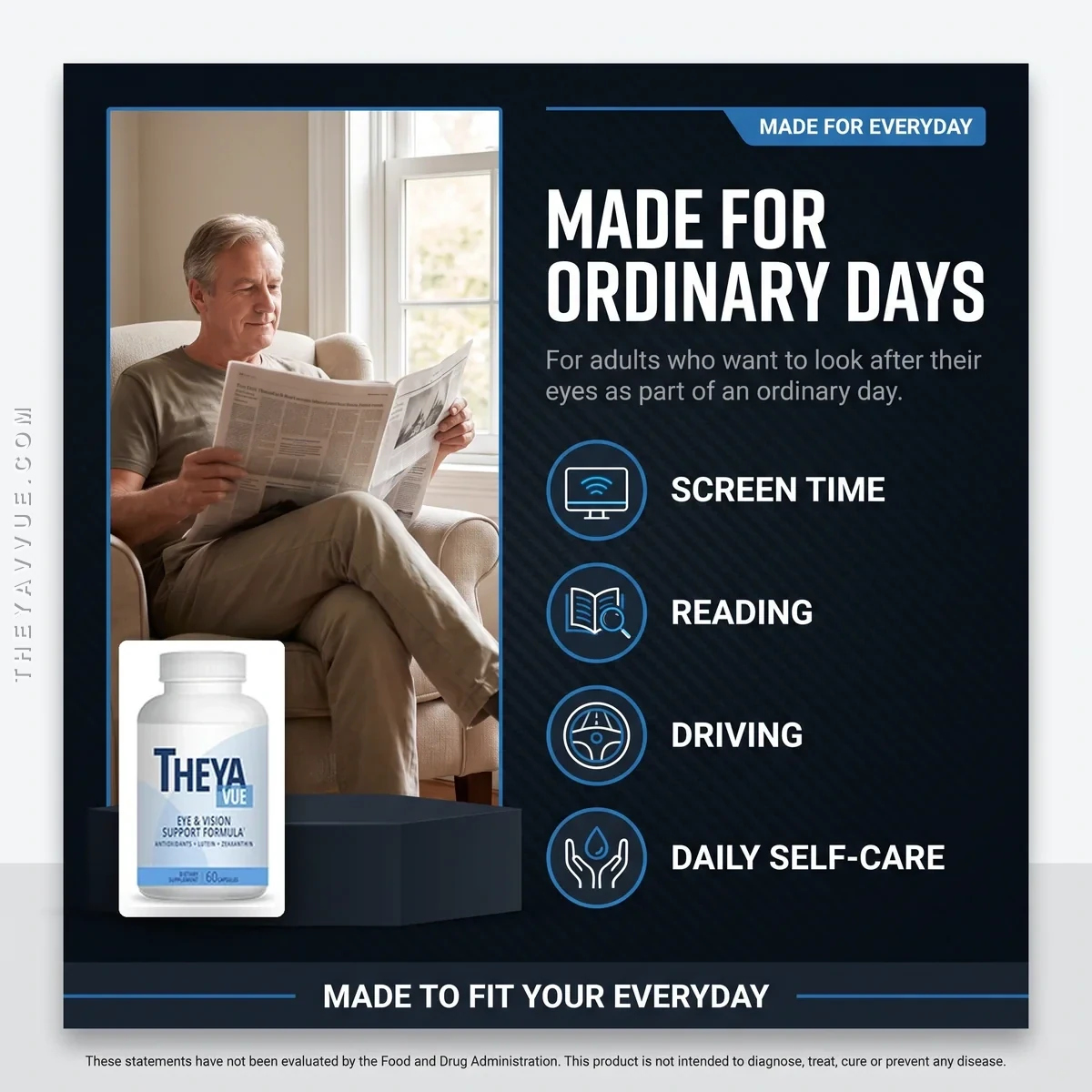
“For adults who want to look after their eyes as part of an ordinary day.” That is the seller’s own sentence, printed under a photograph of somebody in their fifties reading a newspaper by a window.
The four situations named beside it are screen time, reading, driving and daily self-care. None of them is a condition. All four are things most working adults do every day.
The pack adds one line: adults, 18 and over, follow the label. The bottle itself carries the standard caution about pregnancy, nursing, under-18s and known medical conditions.
Read together, the intended buyer is somebody without a diagnosis who has decided their eyes are worth a daily habit. That is a modest position and it is the right one for a supplement. The trouble on this shelf is usually the opposite: products written as though everybody with tired eyes has a retinal problem.
Four people TheYavue genuinely suits
Somebody whose day is mostly screens
A 2022 review reviewed the association between visual display terminal work and dry eye, and a 2020 study measured it against hours of exposure. The symptoms are real and widespread.
What a carotenoid formula offers here is pigment support rather than symptom relief, and it works alongside the things that actually move screen symptoms: blinking, breaks and screen distance. Somebody who will do both gets more out of it than somebody expecting the capsule to do the work.
A 2023 trial is the one randomised trial in this area that carried lutein and zeaxanthin rather than astaxanthin alone. It measured eye-hand coordination and smooth pursuit after display work, which is a narrow endpoint and a real one.
Somebody who eats few dark leafy greens
Lutein and zeaxanthin come from kale, spinach, chard, maize and egg yolk. Somebody who eats those most days is already getting the ingredient this bottle leads with.
Somebody who does not is the clearest case for a supplement in this category, and it is the honest version of the argument: it is about filling a dietary gap, not about beating a diet.
Somebody who wants one bottle rather than six
Twenty-four ingredients on one panel is the actual selling point here, and it is a real one. Buying lutein, zeaxanthin, bilberry, alpha lipoic acid, a B complex, zinc and copper separately costs more and requires more of a person.
The price of that convenience is the blend. Whether it is a fair price is the decision this whole website is trying to put in front of you.
Somebody who will give it two months
The 60-day window is not marketing generosity. It is the span the pigment research runs on and roughly what buyers here report before they had anything to judge.
Somebody who intends to decide at day ten will decide wrongly, and the guarantee will not have done its job.
Four people who should buy something other than TheYavue
Anybody who needs a milligram figure
If your reason for buying is to hit AREDS2’s 10 mg of lutein and 2 mg of zeaxanthin, this label cannot confirm you have. A single-ingredient lutein product or an AREDS2-formula product prints the number. That is a real advantage and this desk is not going to argue around it.
Anybody already taking zinc
Thirty-two milligrams a day from this bottle is eighty per cent of the 40 mg adult upper level. Add a multivitamin or an immune formula and the total goes over, and a systematic review of zinc toxicity and a case report of zinc-induced copper deficiency describe where sustained excess leads.
Anybody under 18
The label says 18 and over and this is not a formality. A panel carrying 2,666% of a daily value of biotin and 40 mg NE of niacin is written against adult reference intakes, and a child’s are different.
Anybody with a new visual symptom
New floaters, flashes, a curtain in the field, sudden blurring, or pain. Those need an eye examination within days. Starting a supplement instead delays the thing that would have found the cause, and that is the only genuinely harmful way to use a bottle like this.
The groups TheYavue is not written for
Two documents govern here and it is worth saying which is which before the table.
The distributor’s precaution block states four things: healthy adults aged 18 and over only, not for anyone under 18, speak to a doctor before use if you take medicine, and do not exceed the label unless a clinician says so. Those are the exclusions with a source behind them.
The bottle itself almost certainly carries a printed caution paragraph as well. This desk has not read one: the label artwork supplied is of the front panel, and no caution text is legible on it. So nothing on this website is presented as a quotation from that paragraph, and the gaps below are named as gaps.
| Group | Where it comes from | The practical reading |
|---|---|---|
| Anyone under 18 | Stated outright in the precaution block | A flat exclusion. The panel is written against adult reference intakes, and 2,666% of a daily value of biotin is an adult figure. |
| Anyone not in good health | “For healthy adults”, in the same block | Read it alongside the two rows with published ceilings. Zinc at 32 mg a day and niacin at 40 mg NE are where a condition would matter most. |
| Anyone taking medicine | Stated outright in the precaution block | Bring the bottle rather than the name. A pharmacist reads a panel in seconds and cannot look up a proprietary blend. |
| Anyone tempted to take more | “Do not take more than the label” | Doubling up after a missed capsule pushes the niacin further past its ceiling and buys nothing. |
| Pregnancy and nursing | NOT named anywhere in the precaution block | Almost every label in this category carries such a line, so this is a gap in the paperwork rather than evidence the bottle is silent. Treat it as a question for whoever has your notes. |
The middle column is the source, not a quotation. Where the precaution block is silent, the row says so.
And one the paperwork does not raise at all: if you have blood work booked, mention the biotin. A 2022 review of assay interference sets out why. It is a ninety-second conversation that saves a repeat test.
What TheYavue buyers actually look like, on the distributor’s figures
Eight reviewers appear in the distributor’s own summary. Their ages run from 44 to 64, the median is around fifty, and every one of them is past day 39 at the point of writing. Five bought six bottles.
That is a narrow and self-selecting sample, and it is the seller’s marketing material rather than evidence. What it is useful for is a sense of who reaches the point of writing anything down: people in their forties, fifties and sixties who committed to several months.
| What the roster shows | |
|---|---|
| Age range | 44 to 64 |
| Days at review | 39 to 59 |
| Most common pack | 6 bottles |
| Split | Five at five stars, three at three |
| What the fives say | The daily habit stuck and they reordered early |
| What the threes say | They wanted a faster change and stopped at two bottles |
These are the distributor’s own summary figures. They are not verified transcripts and they are not evidence about the product.
The full roster and one figure in it that does not add up are on TheYavue reviews.
Who TheYavue suits: common questions
Is TheYavue only for older adults?
No. The label says 18 and over, and the seller’s own four use cases are screen time, reading, driving and self-care, which describe most working adults. The reviewers the distributor prints happen to be in their forties to sixties.
Can I take TheYavue if I wear glasses or contacts?
Yes, and it will not change the prescription. Refractive error is about the shape of the eye and the focusing power of the lens. Nothing in this bottle alters either, and the bottle does not say it does.
Should I take TheYavue if I already have macular degeneration?
That is a conversation with the ophthalmologist who made the diagnosis. The AREDS trials were run in people who already had one, under specialist care, on a specific formula whose amounts are printed. This is a supplement with a blend, and it is not the same thing.
Is TheYavue suitable for vegetarians?
The capsule shell is cellulose and the other ingredients are rice flour, magnesium stearate and silicon dioxide. The vegetarian mark checks out against the label, which is worth saying because on plenty of bottles it does not.
Does TheYavue suit somebody who takes a multivitamin?
Add the zinc up first. This bottle supplies 32 mg a day and the adult upper intake level is 40 mg. If the multivitamin carries zinc as well, one of the two probably has to go.
The sources behind this TheYavue audience page
Nine records, each confirmed through the NCBI summary API in this session, plus the FDA's consumer guidance.
- Fjaervoll H, Fjaervoll K, Magno M, et al. The association between visual display terminal use and dry eye: a review. Acta Ophthalmol. 2022;100(4):357-375. PMID 34697901. https://pubmed.ncbi.nlm.nih.gov/34697901/
- Sánchez-Valerio MDR, Mohamed-Noriega K, Zamora-Ginez I, et al. Dry eye disease association with computer exposure time among subjects with computer vision syndrome. Clin Ophthalmol. 2020;14:4311-4317. PMID 33335383. https://pubmed.ncbi.nlm.nih.gov/33335383/
- Yoshida K, Sakai O, Honda T, et al. Effects of astaxanthin, lutein, and zeaxanthin on eye-hand coordination and smooth-pursuit eye movement after visual display terminal operation in healthy subjects: a randomized, double-blind placebo-controlled intergroup trial. Nutrients. 2023;15(6):1459. PMID 36986186. https://pubmed.ncbi.nlm.nih.gov/36986186/
- Dutta A, Chaudhary V, Kumari S, et al. Zinc-induced hematologic toxicities: a systematic review of descriptive studies. Biol Trace Elem Res. 2026;204(9):6628-6642. PMID 42087025. https://pubmed.ncbi.nlm.nih.gov/42087025/
- Mims MH, Reid ES, Hash MG, et al. A hematologic twist: zinc-induced copper deficiency mimicking myelodysplastic syndrome. Cureus. 2025;17(7):e87624. PMID 40786321. https://pubmed.ncbi.nlm.nih.gov/40786321/
- Dasgupta A. Immunoassay design and biotin interference. Adv Clin Chem. 2022;109:165-183. PMID 35953126. https://pubmed.ncbi.nlm.nih.gov/35953126/
- Age-Related Eye Disease Study 2 (AREDS2) Research Group. Lutein + zeaxanthin and omega-3 fatty acids for age-related macular degeneration: the Age-Related Eye Disease Study 2 (AREDS2) randomized clinical trial. JAMA. 2013;309(19):2005-15. PMID 23644932. https://pubmed.ncbi.nlm.nih.gov/23644932/
- Age-Related Eye Disease Study Research Group. A randomized, placebo-controlled, clinical trial of high-dose supplementation with vitamins C and E, beta carotene, and zinc for age-related macular degeneration and vision loss: AREDS report no. 8. Arch Ophthalmol. 2001;119(10):1417-36. PMID 11594942. https://pubmed.ncbi.nlm.nih.gov/11594942/
- Questions and Answers on Dietary Supplements. U.S. Food and Drug Administration. https://www.fda.gov/food/information-consumers-using-dietary-supplements/questions-and-answers-dietary-supplements
Order TheYavue on the official website
For adults over 18 who will give a daily capsule two months. Sixty days to decide, opened bottles included.
One bottle $59 · six bottles $234 · 60-day money-back guarantee
Order TheYavue On The Official WebsiteOne capsule twice a day · 60 a bottle · lot THE-26/TH-4593