TheYavue Official Website › Blog › Beta-carotene
Beta-carotene in an eye formula, after AREDS2 took it out
AREDS2 removed beta-carotene from the eye supplement formula because of a cancer signal in smokers. TheYavue carries it anyway, as its vitamin A source, at 100 mcg RAE a day. This article is about why both of those facts are true and why the second one is not the problem it sounds like.
The signal that removed it
In the 1980s and 1990s, beta-carotene was one of the most promising compounds in preventive medicine. It is the plant precursor of vitamin A, it is abundant in vegetables, and people who ate more of those vegetables had less cancer. Two large trials were run to test whether supplementing it would reproduce the effect.
They found the opposite. In smokers and in asbestos-exposed workers, supplemental beta-carotene was associated with higher lung cancer incidence rather than lower.
A 2010 systematic review and meta-analysis pooled the randomised trials and confirmed the association across them. A 2023 update reached the same place with more data. A Cochrane review covers beta-carotene among the compounds studied for lung cancer prevention and reports what the evidence supports.
The mechanism is still argued about. The finding is not.
Why AREDS had it in the first place
The original AREDS trial was designed before that literature had settled. Its antioxidant arm was vitamin C at 500 mg, vitamin E at 400 IU and beta-carotene at 15 mg a day, alongside a zinc arm at 80 mg with 2 mg of copper.
The formula worked, in the sense that it reduced progression to advanced macular degeneration in people who already had the disease. It was also, by the time it reported, a formula that could not responsibly be given to a large fraction of the people who needed it, because a great many older adults with macular degeneration are current or former smokers.
That is the practical problem AREDS2 was built to solve. Lutein and zeaxanthin went in, beta-carotene came out, and the substitution performed at least as well without the caveat.
It is one of the cleaner examples in nutritional medicine of a trial being redesigned around a safety finding rather than around a marketing opportunity.
The amount on this label, against the amounts in the trials
Here is where the alarm subsides, and it subsides completely.
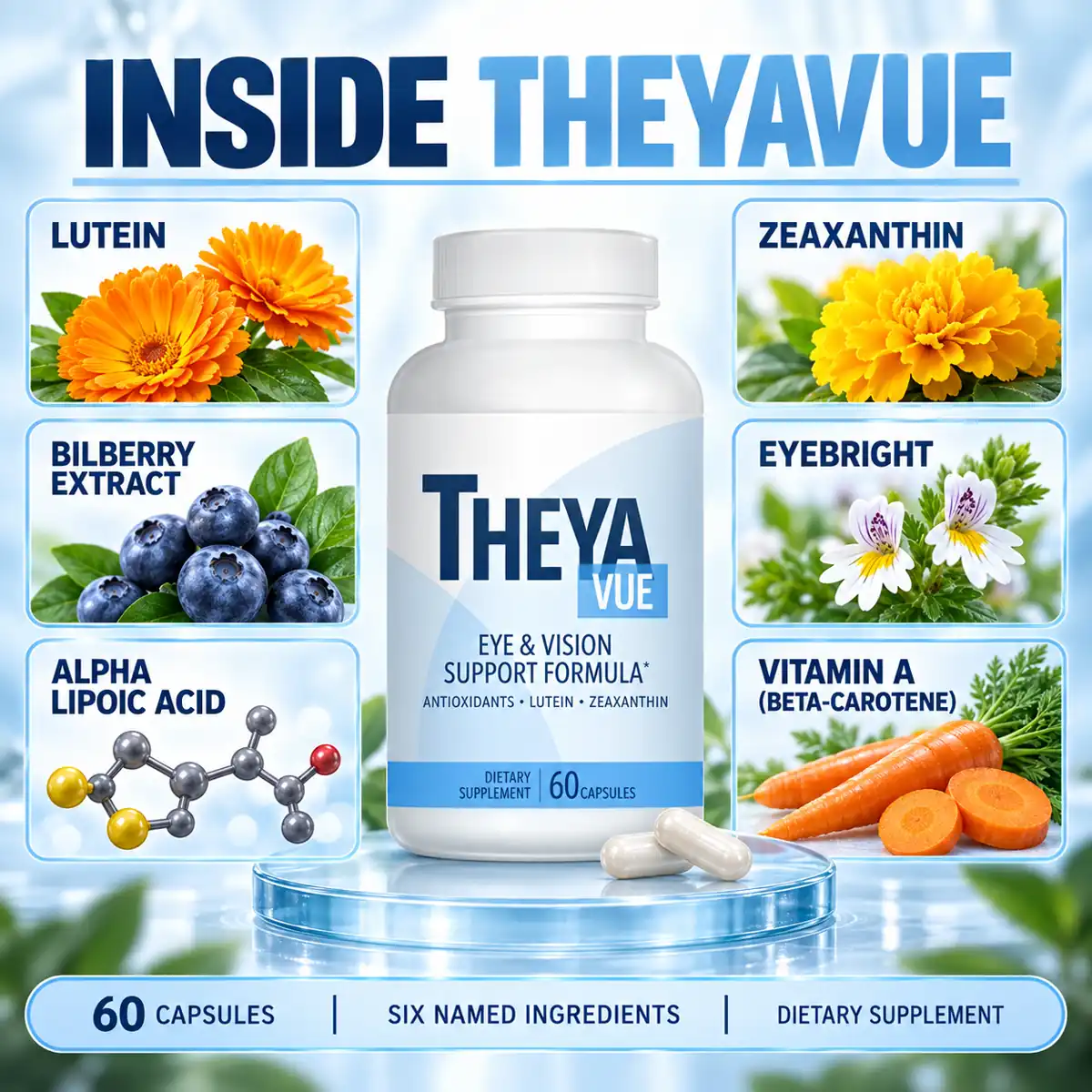
The TheYavue panel prints Vitamin A (as Beta-carotene) at 50 mcg RAE per capsule, which is 100 mcg RAE a day at the label’s two-capsule direction. Five per cent of a daily value per capsule, ten per cent a day.
The trials that found the lung cancer signal used 20 to 30 mg of beta-carotene a day. AREDS used 15 mg. This bottle supplies something in the region of 200 mcg of beta-carotene a day, which is roughly a hundredth of the AREDS dose and closer to a thousandth of the trial doses.
One analysis looked specifically at the beta-carotene amounts in retail multivitamins, for exactly this reason: the amount matters, and the gap between a supplement dose and a trial dose is often enormous.
So the ingredient with the most alarming history in this category is present here in an amount that cannot reproduce the finding. That is the honest answer and it is a reassuring one.
| The trials that found the risk | AREDS | TheYavue | |
|---|---|---|---|
| Beta-carotene a day | 20 to 30 mg | 15 mg | 100 mcg RAE |
| Roughly, as beta-carotene | 20,000 to 30,000 mcg | 15,000 mcg | About 200 mcg |
| Population | Smokers and asbestos-exposed workers | People with macular degeneration | General adult buyers |
| Duration | Years | Six years or more | As long as somebody takes it |
| Outcome | Raised lung cancer incidence | The formula worked, with that caveat | No comparable exposure |
Conversion between mcg RAE and mcg of beta-carotene depends on the source; supplemental beta-carotene converts at roughly 2 mcg to 1 mcg RAE. Either way the final column is two orders of magnitude below the first.
Order TheYavue on the official website
Vitamin A as beta-carotene at 100 mcg RAE a day, roughly a hundredth of the AREDS dose, alongside lutein and zeaxanthin. Sixty days to decide, opened bottles included.
One bottle $59 · six bottles $234 · 60-day money-back guarantee
Order TheYavue On The Official WebsiteOne capsule twice a day · 60 a bottle · lot THE-26/TH-4593
The odd part: both the old ingredient and its replacement
What is genuinely unusual about this label is not the beta-carotene. It is that the beta-carotene and the ingredients that replaced it are on the same panel.
AREDS2 was a substitution. Out with one, in with two. A formula carrying all three is not reproducing either trial; it is carrying the vitamin A row a general multivitamin would have, and separately carrying the carotenoid pair an eye formula would have.
Once you see it that way the whole label makes more sense. This is a multivitamin with an eye blend attached, rather than an AREDS2 replica, and the beta-carotene is there doing the job vitamin A does in any multivitamin rather than the job it did in AREDS.
At 100 mcg RAE a day it is not doing very much of either. Ten per cent of a daily value is a token amount, and calling it that is more accurate than treating it as a design decision.
There is a second reason the amount matters here and it has nothing to do with safety. At 100 mcg RAE a day this row is not supplying meaningful vitamin A either. Ten per cent of a daily value is not a deficiency-correcting intake for anybody, so the row is not doing the job an eye formula might want from it and not doing the job a multivitamin might want from it.
That is the more ordinary criticism of this panel and it applies to four other rows as well. Calcium at four per cent of a daily value, magnesium at ten, selenium at fourteen and chromium at ten are all in the same position: present on the label, absent in effect. The beta-carotene is simply the one with a famous history attached.
| Question | Answer |
|---|---|
| Is beta-carotene in this formula? | Yes, as the vitamin A source |
| How much? | 50 mcg RAE a capsule, 100 mcg RAE a day |
| Is that near the amount linked to raised risk? | No. Roughly a hundredth of it |
| Should a smoker take it anyway? | That is a conversation with a clinician, and the amount makes it a short one |
| Did AREDS2 remove beta-carotene? | Yes, and replaced it with lutein and zeaxanthin |
| Does this product carry lutein and zeaxanthin too? | Yes, both, inside the proprietary blend |
The last two rows together are the odd part: this formula carries the ingredient AREDS2 removed AND the ingredients it was replaced with.
What a smoker or former smoker should do
The question this article exists to answer, and it has a short answer and a longer one.
The short answer: the amount here is not comparable to the amounts that produced the finding, by two orders of magnitude. The beta-carotene on this label is not a reason for a smoker to avoid it.
The longer answer is that anybody who smokes, or who used to, and who is thinking about supplements for their eyes is already in a conversation worth having with a clinician. Smoking is the single largest modifiable risk factor for macular degeneration, which is a much larger fact than anything on a supplement panel.
And the general principle holds regardless: take the bottle to the appointment. A Supplement Facts panel reads in seconds and a brand name does not.
- The trials that found the risk used 20 to 30 mg of beta-carotene a day.
- AREDS used 15 mg, which is why AREDS2 removed it.
- TheYavue supplies 100 mcg RAE a day, roughly a hundredth of the AREDS amount.
- It also carries lutein and zeaxanthin, the ingredients that replaced it.
- Smoking itself is a far larger risk factor for macular degeneration than any panel row.
The transferable lesson
Two things worth taking away from this to every other label you read.
The first is that an ingredient is not a dose. “Contains beta-carotene” is compatible with a hundredth of a trial amount and with three times one. A claim about safety or about efficacy that does not name an amount is not a claim about anything.
The second is that the same arithmetic runs in both directions. It is the reason the beta-carotene here is fine, and it is the reason the bilberry in the same blend cannot reach its trial dose. A reader who applies it consistently will reassure themselves about some rows and disappoint themselves about others, which is what reading a label honestly feels like.
The rest of the panel, with the dose each ingredient’s research used beside it, is on the ingredients page.
The ingredient that ended the first AREDS formula is on this label in an amount that cannot reproduce the problem, alongside the two ingredients that replaced it.
New floaters, flashes of light, a shadow across part of your vision, sudden blurring or pain in the eye need an examination within days. No supplement and no article is a reason to wait. If you take prescription medicine, take the bottle to a pharmacist: a Supplement Facts panel reads in seconds and a brand name does not.
References
- Age-Related Eye Disease Study Research Group. A randomized, placebo-controlled, clinical trial of high-dose supplementation with vitamins C and E, beta carotene, and zinc for age-related macular degeneration and vision loss: AREDS report no. 8. Arch Ophthalmol. 2001;119(10):1417-36. PMID 11594942. https://pubmed.ncbi.nlm.nih.gov/11594942/
- Age-Related Eye Disease Study 2 (AREDS2) Research Group. Lutein + zeaxanthin and omega-3 fatty acids for age-related macular degeneration: the Age-Related Eye Disease Study 2 (AREDS2) randomized clinical trial. JAMA. 2013;309(19):2005-15. PMID 23644932. https://pubmed.ncbi.nlm.nih.gov/23644932/
- Zhang Y, Yang J, Na X, et al. Association between beta-carotene supplementation and risk of cancer: a meta-analysis of randomized controlled trials. Nutr Rev. 2023;81(9):1118-1130. PMID 36715090. https://pubmed.ncbi.nlm.nih.gov/36715090/
- Druesne-Pecollo N, Latino-Martel P, Norat T, et al. Beta-carotene supplementation and cancer risk: a systematic review and metaanalysis of randomized controlled trials. Int J Cancer. 2010;127(1):172-84. PMID 19876916. https://pubmed.ncbi.nlm.nih.gov/19876916/
- Tanvetyanon T, Bepler G. Beta-carotene in multivitamins and the possible risk of lung cancer among smokers versus former smokers: a meta-analysis and evaluation of national brands. Cancer. 2008;113(1):150-7. PMID 18429004. https://pubmed.ncbi.nlm.nih.gov/18429004/
- Cortés-Jofré M, Rueda JR, Asenjo-Lobos C, et al. Drugs for preventing lung cancer in healthy people. Cochrane Database Syst Rev. 2020;3(3):CD002141. PMID 32130738. https://pubmed.ncbi.nlm.nih.gov/32130738/