TheYavue Official Website: Eye and Vision Support with Lutein and Zeaxanthin
TheYavue is a veggie capsule for eye and vision support, taken one capsule twice a day.
A bottle holds 60 capsules, a month at that rate. The panel prints an amount for 14 nutrients and folds 10 more, lutein and zeaxanthin among them, into a 240.5 mg blend. Bottles run $39 to $59 with a 60-day guarantee.
This page covers what the panel prints, what the blend hides, how each amount compares with the dose its research used, how long buyers here wait before judging it, what it costs on the official website, and how the 60-day guarantee works.
Free US shipping on 3 & 6 bottles One-time payment, no subscription 60-day money-back guarantee
- One capsule twice daily
- 60 capsules a bottle
- 14 nutrients with printed amounts
- 240.5 mg blend of 10
- 60-day guarantee
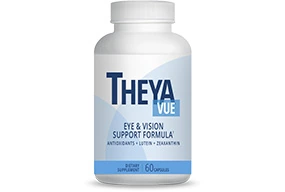
Lot THE-26/TH-4593 · 60 capsules · one twice a day
What TheYavue is, and what a bottle of it covers
TheYavue is a capsule taken twice a day, in the morning and again later, each one swallowed 20 to 30 minutes before a meal with a full glass of water. Sixty capsules a bottle at that rate is thirty days, which lines the pack ladder up neatly: one bottle is a month, three bottles a quarter, six bottles half a year.
The front panel commits to one thing and repeats it twice. Eye & Vision Support Formula runs across the middle of the label, and the line beneath it reads Antioxidants · Lutein · Zeaxanthin. Those two carotenoids are the reason this category exists: they are the pigments the macula concentrates, and they are what the large eye trials of the last twenty-five years have mostly been about.
Behind that front panel is a Supplement Facts table with more on it than the category average. Fourteen vitamins and minerals carry a printed amount and a percentage daily value. Ten further ingredients sit inside a single 240.5 mg proprietary blend. Fourteen plus ten is twenty-four, which is where the seller’s own “24 antioxidants” line comes from, and it is a fair count.
So a buyer gets two different kinds of disclosure on one bottle. For the vitamins and minerals the numbers are all there and can be compared against anything. For the ten that most people are actually shopping for, there is one total and an order of weight. This website prints both halves and treats them differently, because they deserve to be treated differently.
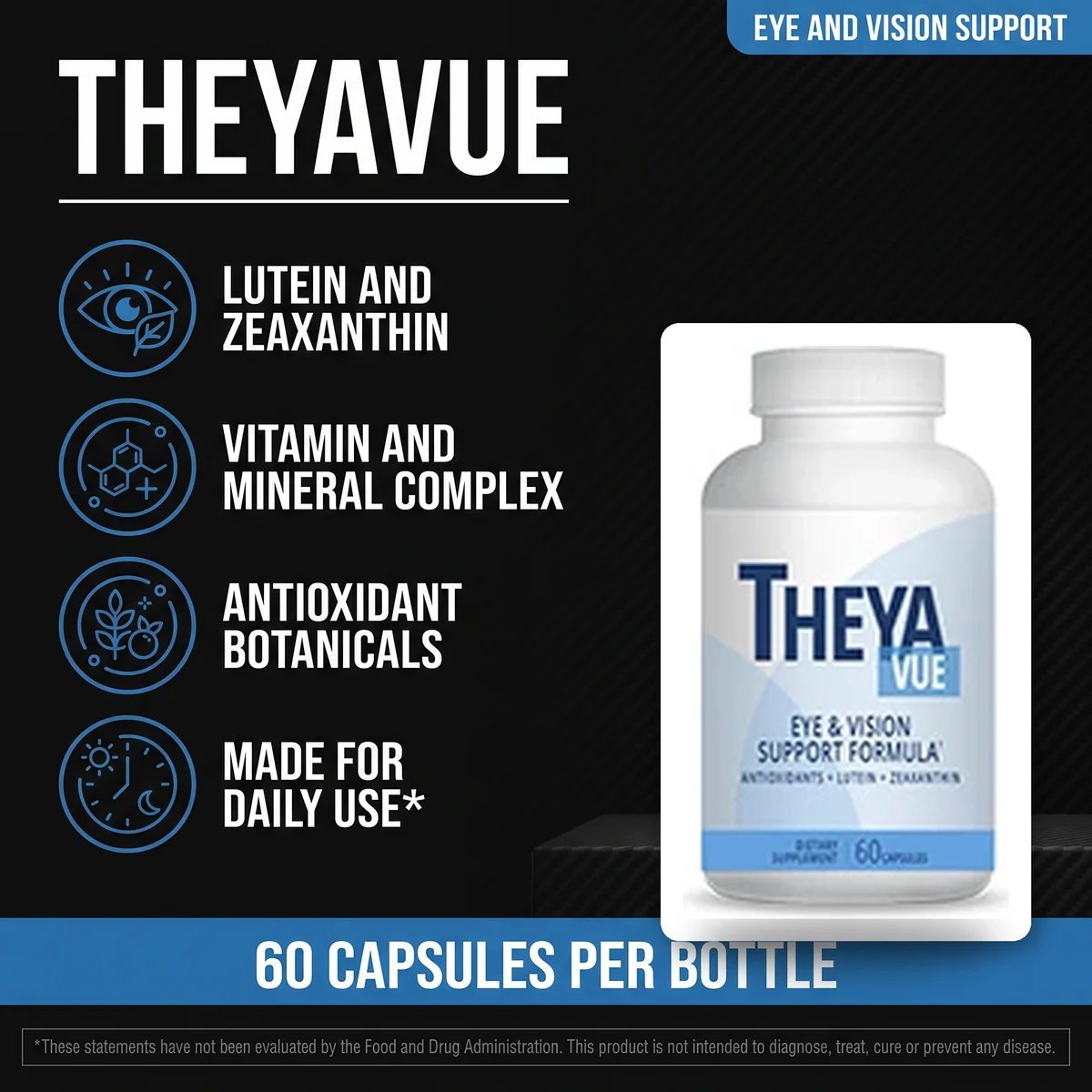
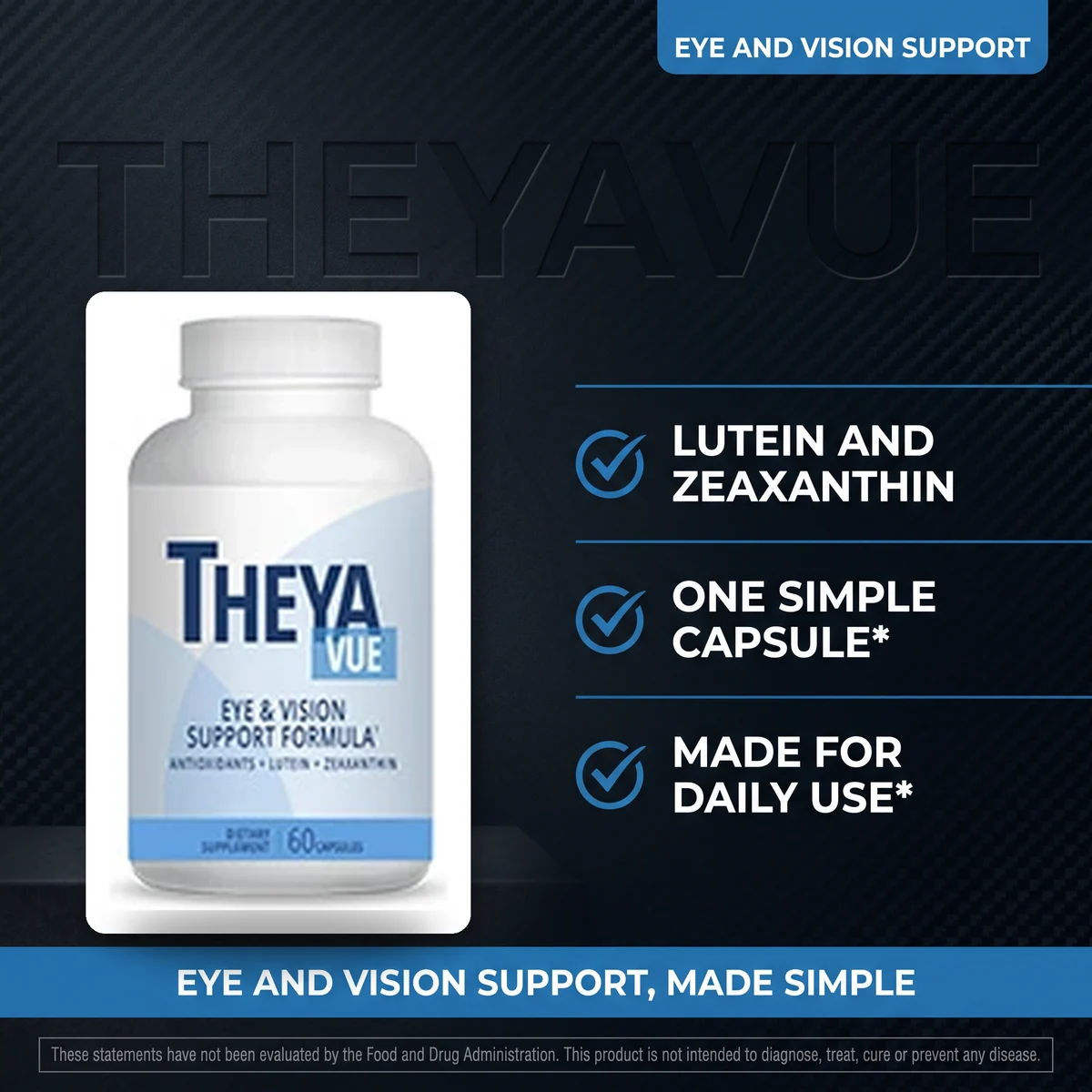
The seller’s own summary of the bottle names four things: lutein and zeaxanthin, a vitamin and mineral complex, antioxidant botanicals, and daily use. All four map onto something real on the panel. The vitamin and mineral complex is the fourteen printed rows; the antioxidant botanicals are most of the blend.
What the graphic does not say, and what the panel does, is that the botanicals share one weight between them.
Inside TheYavue: twenty-four ingredients on one panel
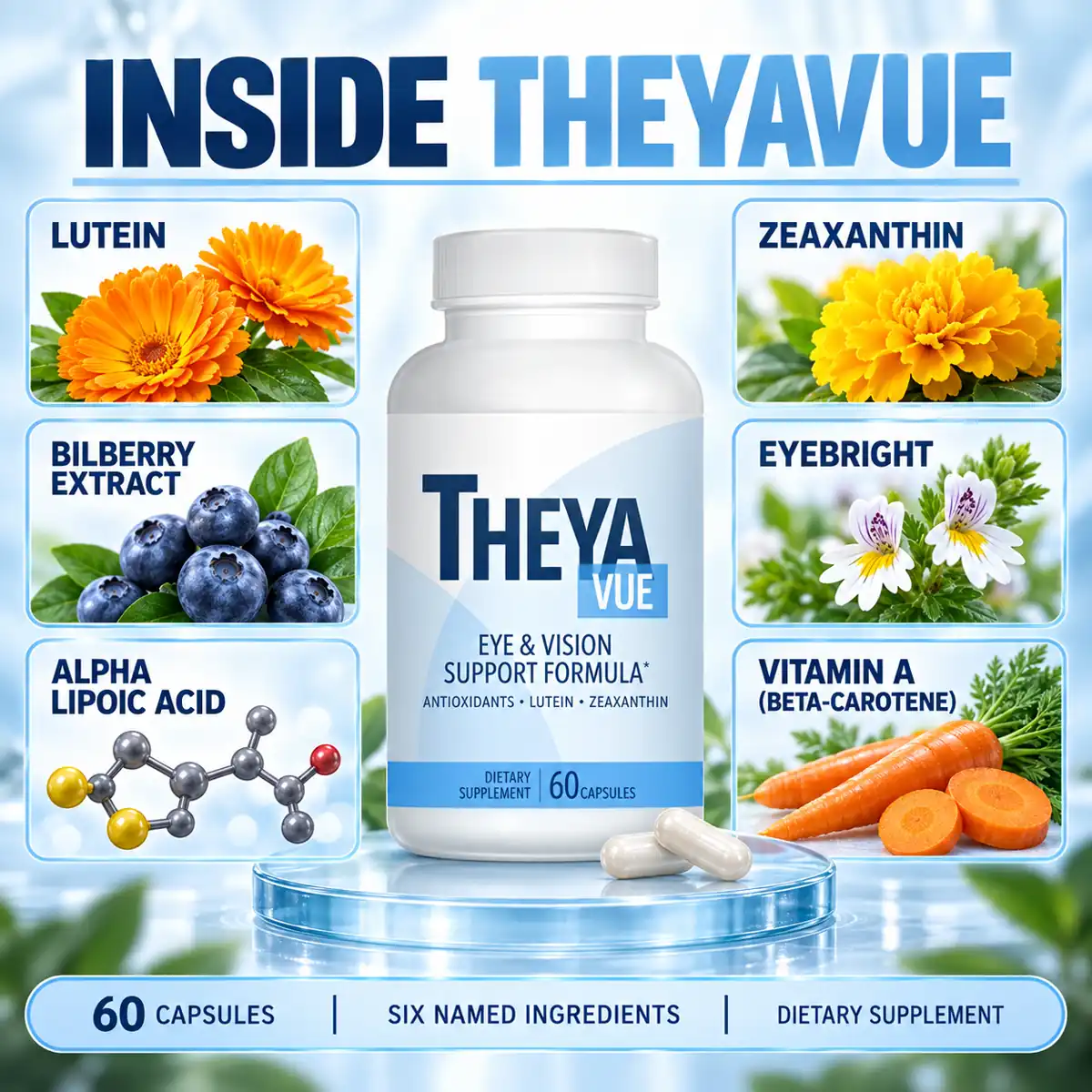
The vendor’s ingredient graphic names six: lutein, zeaxanthin, bilberry extract, eyebright, alpha lipoic acid and vitamin A as beta-carotene. All six are genuinely on the panel. The graphic is a short extract of the label rather than the whole of it.
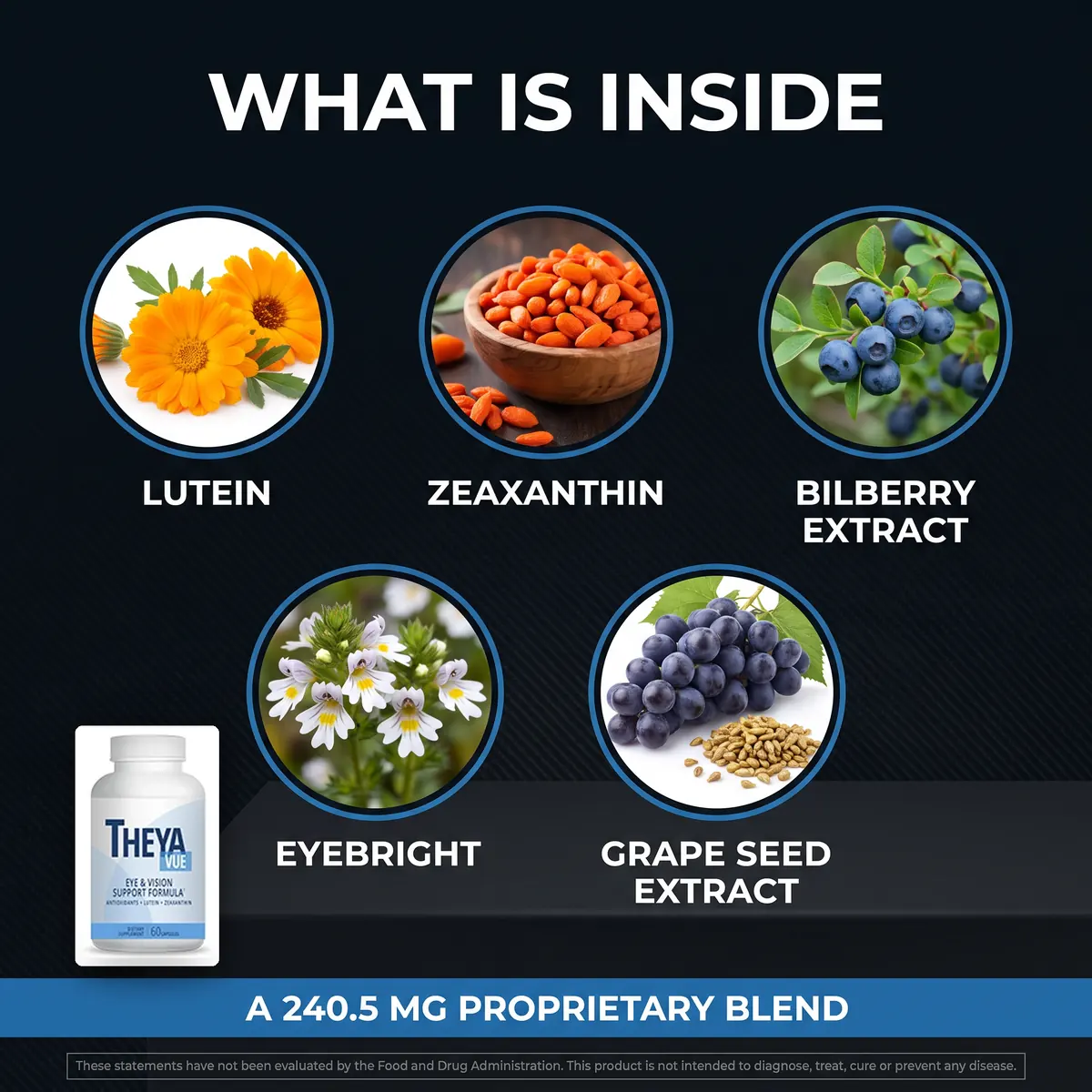
A second graphic from the same seller drops two of those six and adds grape seed extract. That one is also telling the truth: grape seed is in the blend, ninth by weight. Neither picture is wrong; both are partial, and the panel is the thing that settles it.
Read in full, the panel divides cleanly. Vitamin C at 100 mg a capsule and zinc at 16 mg are the two printed rows that carry real weight for eyes. Vitamin E, copper, vitamin A and the B vitamins fill out a multivitamin base. Calcium, magnesium, selenium and chromium appear at a few percent of a daily value each, which is a gesture rather than a dose.
Then the blend, in the order the label prints it, which by law is the order of weight: lutein, bilberry, alpha lipoic acid, eyebright, zeaxanthin, quercetin, rutin, L-taurine, grape seed, lycopene.
- 1LuteinThe xanthophyll the macula concentrates. First by weight of the ten.
- 2Bilberry Extract (Vaccinium myrtillus) (fruit)An anthocyanin-rich berry extract, second by weight.
- 3Alpha Lipoic Acid (ALA)A fat- and water-soluble antioxidant, third by weight.
- 4Eyebright (Euphrasia officinalis) (herb)A traditional eye herb, fourth by weight.
- 5ZeaxanthinLutein's partner pigment, concentrated at the very centre of the macula. Fifth by weight, so there is less of it here than of the four above.
- 6Quercetin (Sophora japonica) (bud)A flavonol, sixth by weight.
- 7Rutin (Sophorae japonica L.) (flower)A flavonoid glycoside from the same plant as the quercetin, seventh.
- 8L-TaurineAn amino acid the retina holds at high concentration, eighth.
- 9Grape Seed Extract (Vitis vinfera L.) (seed)A proanthocyanidin source, ninth. The distributor's product sheet never names it.
- 10LycopeneThe tomato carotenoid, tenth and therefore the smallest of the ten.
That order is worth reading twice. Lutein leads, which is the right place for it on an eye formula. Zeaxanthin is fifth, behind three botanicals, and zeaxanthin is the pigment that sits at the very centre of the macula. In the AREDS2 trial the two were given together at 10 mg and 2 mg, a five-to-one ratio, so lutein outweighing zeaxanthin is exactly what you would expect. Where the two sit relative to bilberry and alpha lipoic acid is the part the label does not answer.
The full ingredient page walks each of the twenty-four, with the dose its research used beside it: TheYavue ingredients.
How TheYavue is meant to work, read off its own panel
Two mechanisms are doing the work on this label, and they run on different clocks.
The first is macular pigment. Lutein and zeaxanthin are not made in the body; they arrive from food and they accumulate in the retina over weeks and months. A 2024 network meta-analysis measured that accumulation directly across a run of trials and found supplementation raises it. What the pigment does there is physical: it takes up the short end of the visible spectrum before that light reaches the photoreceptors, in a tissue with one of the highest oxygen demands in the body. None of that happens quickly, and a formula resting on it cannot honestly be sold as if it did.
The second is a general antioxidant and micronutrient base. Vitamin C, vitamin E, zinc and copper are the four the original AREDS trial built its formula from, and the reason they are here. Zinc in particular is the one printed amount on this panel that lands in a defensible range, which is worth saying plainly in a section about what works.
Where the two meet is absorption. Carotenoids are fat-soluble, and they need fat in the gut to get across. That is the one place the label’s directions and the research point in slightly different directions, and it is covered on how to take it rather than here.
Swallowed before a meal
One capsule, 20 to 30 minutes before eating, with 8 oz of water. The second capsule goes with the second meal of the day.
Absorbed with dietary fat
The carotenoids cross with fat. A single-dose absorption trial found that the oil a lutein capsule is suspended in changes how much reaches the blood.
Deposited in the macula
Lutein and zeaxanthin concentrate in the retina. Measured optical density rises over weeks, not days, which is the timeline this whole category runs on.
Supported by the printed base
Vitamin C, vitamin E, zinc and copper make up the antioxidant base the AREDS trials tested, here at a fraction of those doses except for the zinc.
The longer version, including what macular pigment optical density is and why it is the measure these trials use, is on how TheYavue works.
The TheYavue panel, printed both ways
Here is the Supplement Facts table as the bottle prints it, with a second pair of columns showing the same panel at the label’s own directions. The bottle’s serving is one capsule. The directions ask for two a day. Both columns are the label; the right-hand pair is simply the one a reader is actually going to consume.
| As the label prints it | Per 1 capsulethe panel’s own serving | Per dayat one capsule twice daily | ||
|---|---|---|---|---|
| Amount | %DV | Amount | %DV | |
| Vitamin A (as Beta-carotene) | 50 mcg RAE | 5% | 100 mcg RAE | 10% |
| Vitamin C (as Ascorbic Acid) | 100 mg | 111% | 200 mg | 222% |
| Calcium (as Calcium carbonate) | 25 mg | 2% | 50 mg | 4% |
| Vitamin E (DL-Alpha tocopherol acetate) | 10 mg | 66% | 20 mg | 132% |
| Vitamin B1 (as Thiamine mononitrate) | 4 mg | 333% | 8 mg | 666% |
| Vitamin B2 (as Riboflavin) | 4 mg | 307% | 8 mg | 614% |
| Vitamin B3 (as Niacin) | 20 mg NE | 125% | 40 mg NE | 250% |
| Vitamin B12 (as Cyanocobalamin) | 13.5 mcg | 562% | 27 mcg | 1,124% |
| Biotin | 400 mcg | 1,333% | 800 mcg | 2,666% |
| Magnesium (as Magnesium oxide) | 20 mg | 5% | 40 mg | 10% |
| Zinc (as Zinc oxide) | 16 mg | 145% | 32 mg | 290% |
| Selenium (as Selenium AAC) | 4 mcg | 7% | 8 mcg | 14% |
| Copper (as Copper gluconate) | 1 mg | 111% | 2 mg | 222% |
| Chromium (as Chromium picolinate) | 1.8 mcg | 5% | 3.6 mcg | 10% |
| Proprietary Blend | 240.5 mg | † | 481 mg | † |
| Lutein, Bilberry Extract (Vaccinium myrtillus) (fruit), Alpha Lipoic Acid (ALA), Eyebright (Euphrasia officinalis) (herb), Zeaxanthin, Quercetin (Sophora japonica) (bud), Rutin (Sophorae japonica L.) (flower), L-Taurine, Grape Seed Extract (Vitis vinfera L.) (seed), Lycopene | ||||
Serving Size 1 Capsule. Servings Per Container 60. † Daily Value not established. Percent Daily Values are based on a 2,000 calorie diet. Other Ingredients: Cellulose (Vegetable Capsule), Rice Flour, Magnesium Stearate, Silicon Dioxide.
Niacin goes from 20 mg NE to 40 mg NE a day. The published upper-intake analysis puts the adult upper intake level for nicotinic acid at 35 mg, set on flushing rather than on organ damage. Zinc goes from 16 mg to 32 mg against an upper level of 40 mg. Neither is alarming; both are worth knowing before you add a second supplement on top.
Every row, its form, and what that form is good for is on the supplement facts page.
HONEST LABEL ANALYSIS: what the TheYavue blend can and cannot hold
This is the section where the awkward arithmetic lives, and it is confined to this section on purpose.
The blend weighs 240.5 mg a capsule and 481 mg a day. Ten ingredients share it. Federal labelling rules permit exactly this: one total, contents in descending order of weight, no individual figures. It is legal, it is common, and it means a buyer cannot check the one number they came to check.
What that total can comfortably hold is the AREDS2 pair. Ten milligrams of lutein and two of zeaxanthin is twelve, and twelve fits inside 481 with room to spare. What it cannot hold is most of the rest of the list at the doses their own trials used.
The bilberry line is the one to sit with. The 12-week bilberry trial gave 240 mg a day of standardised extract for twelve weeks and measured ciliary muscle contraction. This blend weighs 240.5 mg per capsule in total. One ingredient’s trial dose is the entire blend, to within half a milligram, and bilberry is only second of ten by weight.
Eyebright is a separate problem. It is fourth by weight, and four PubMed searches for a clinical trial of oral Euphrasia officinalis came back with nothing. The only human record is a prospective cohort, a single-arm cohort of eye DROPS in conjunctivitis: different route, different tissue, different question. The other is an in-vitro corneal-cell assay. Neither supports swallowing it for sight, and this desk does not claim otherwise.
The reassuring half of the same reading: the beta-carotene row. AREDS used 15 mg of beta-carotene and AREDS2 removed it, because a 2023 meta-analysis of the trials found a raised cancer risk in smokers at supplemental doses. This bottle carries 100 mcg RAE a day, which is a rounding error beside 15 mg. The ingredient that ended the first formula is present here in an amount that cannot reproduce the problem.
What the TheYavue label claims, and what it does not
Three claims appear on the bottle and the seller’s artwork, and this website does not go past them.
- Eye & Vision Support Formula
- Antioxidants · Lutein · Zeaxanthin
- Made for daily use
Support is the operative word and it is doing real work. A support claim says the ingredients are relevant to how the eye functions. It does not say sight improves, and the bottle never says sight improves.
The sales page this product is sold from carries a headline that does: 3-Second “Rapid Finger Trick” Restores Blurry Eyesight To 20/20. Restoring acuity is a treatment claim. It is not on the bottle, no source in the reference list below supports it, and it does not appear anywhere on this website except in this paragraph, where it is named so that a reader who arrived from that page is not left to wonder why the two do not match.
The full reading of each claim, with what would have to be true for it to hold, is on what the TheYavue label claims.
Who TheYavue is written for
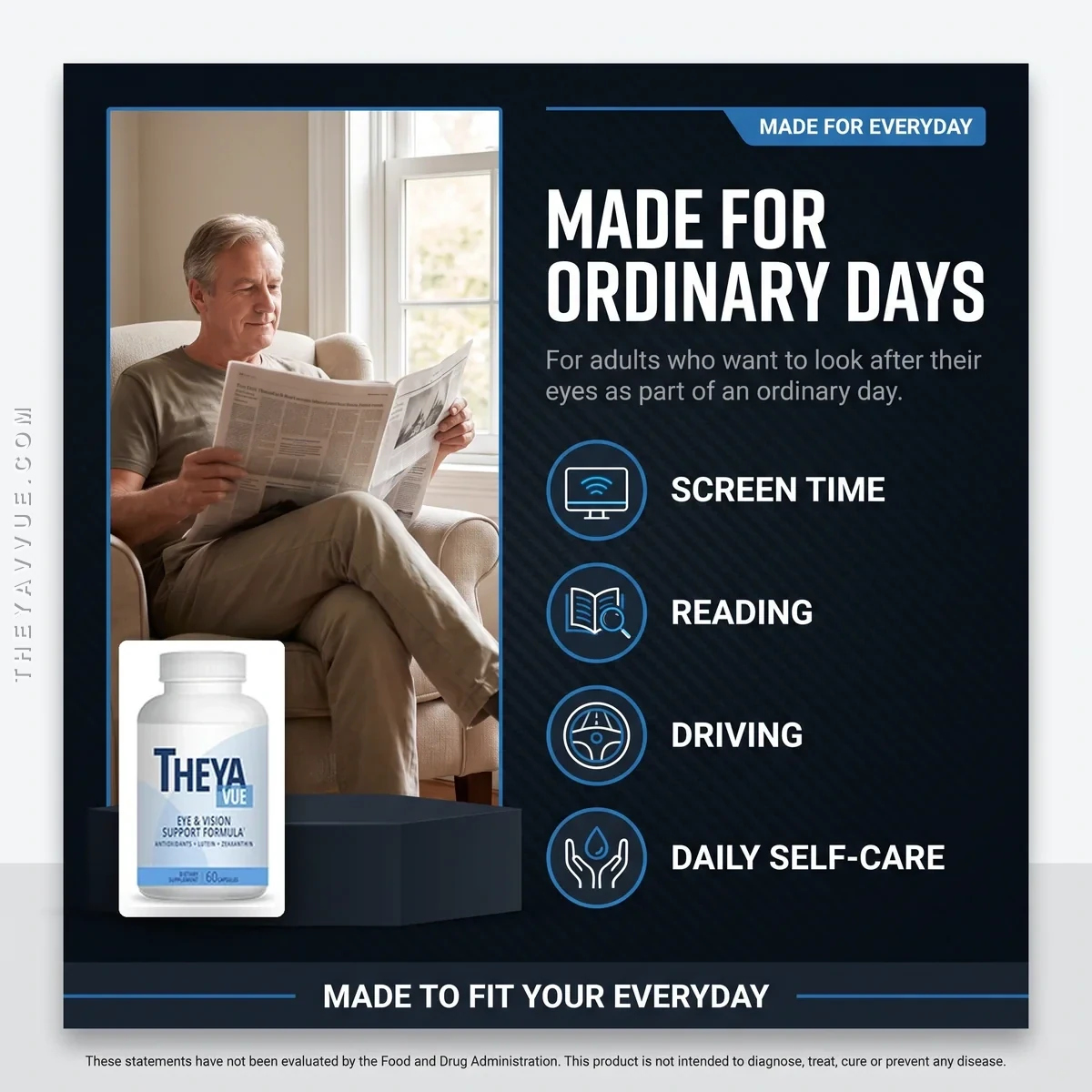
The seller’s own answer is adults who want to look after their eyes as part of an ordinary day, and the four situations named on the artwork are screen time, reading, driving and daily self-care. That is a description of most working adults over forty.
It is also, usefully, a modest answer. Nothing on the graphic suggests the capsule is for a diagnosed condition.
TheYavue suits
- Adults over 18 who spend long stretches on screens. A 2022 review put the association between display work and dry eye on a firm footing.
- People who already eat few dark leafy greens, which are the main dietary route to lutein and zeaxanthin.
- Anyone who wants a single capsule rather than a shelf of separate bottles, and who accepts a blend in exchange for that.
- Buyers who will give it two months. The guarantee is built for that span and so is the biology.
TheYavue does not suit
- Anyone under 18. The label is written for adults and says so.
- Anyone with a diagnosed eye condition looking for a treatment. Those need an ophthalmologist, and this is a supplement.
- Anyone already taking a zinc supplement or a zinc-containing immune formula, without adding up the total first.
- Anyone who needs to know the milligrams. This blend does not disclose them, and no amount of reading changes that.
Two further groups, and the reasoning behind each, are on who TheYavue is for.
Taking TheYavue: the routine the bottle asks for
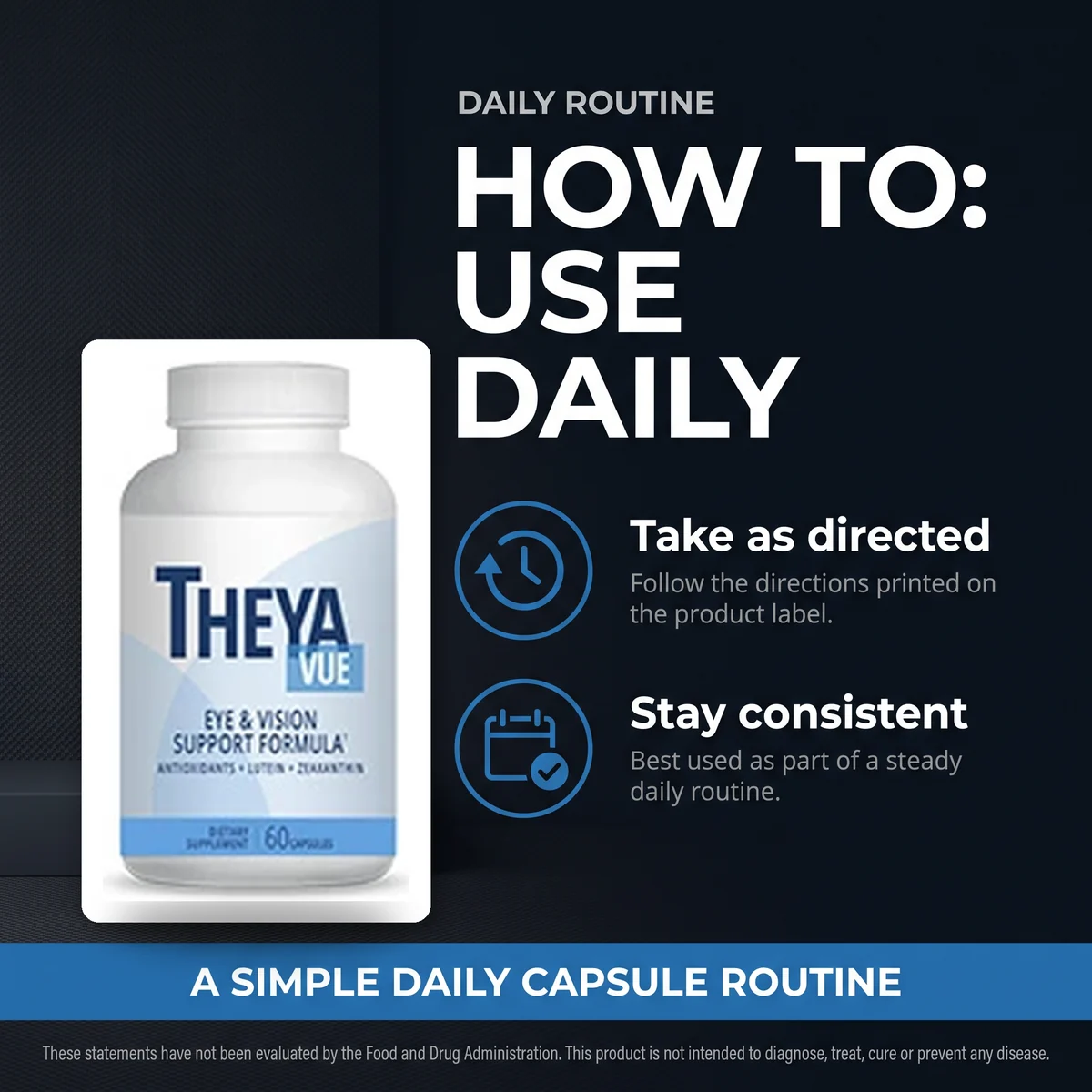
For best results, take one (1) veggie capsule twice daily, 20-30 minutes before a meal with an 8 oz. glass of water
Twice a day, before meals, with water. The seller’s own how-to graphic adds one thing worth repeating: stay consistent. A carotenoid formula rewards the boring version of compliance and punishes a fortnight of skipped days more than most supplements do.
- Before a meal, not instead of one. The water matters less than the meal that follows.
- If you miss a capsule, take the next one at its normal time. Doubling up moves the niacin further past its ceiling for no benefit.
- The second capsule can sit with any meal that has some fat in it. Carotenoids travel with fat, and a formulation comparison found the difference is measurable.
- Mark a start date. Six weeks is the window most buyers here name, and a start date is the only way to know when you have reached it.
The full routine, including what to do about the pre-meal instruction if carotenoid absorption is your priority, is on how to take TheYavue.
How long TheYavue takes, on the seller’s own numbers
Three to six weeks is the wait the distributor’s review summary reports most often, and the eight reviewers it prints are all past day 39. That is consistent with what the pigment research would predict, and it is the number this desk quotes rather than a shorter one.
| Week | What the biology is doing | What buyers here report |
|---|---|---|
| 1 | Absorption begins. Nothing measurable has changed in the retina. | Nothing. The reviews that stop here are the ones that stopped at two bottles. |
| 2 to 3 | Serum carotenoids rise. Pigment density has barely moved. | The routine either sticks or it does not. This is where most people decide. |
| 4 to 6 | Measured macular pigment starts to shift in the published trials. | The window buyers name most often as the point they had something to judge. |
| 7 to 12 | Continued accumulation. The bilberry trial ran 12 weeks to this point. | Reorders cluster here. The six-bottle pack is the one bought most. |
| Beyond | AREDS2 ran five years and reported on ten. | Outside anything the distributor’s figures can speak to. |
The left two columns describe published research on the ingredients. The right column is the distributor’s own review summary, which is marketing material rather than evidence.
A week-by-week reading is on the TheYavue results timeline.
TheYavue pricing on the official website
$59
a bottle$59 total $119
- 1 bottle · 60 capsules
- 30-day supply at two a day
- A small shipping fee, shown at checkout
- Save $60 on the list price
- 60-day money-back guarantee
Lot THE-26/TH-4593 · ships from the U.S.
$49
a bottle$147 total $357
- 3 bottles · 180 capsules
- 90-day supply at two a day
- Free US shipping
- 2 free bonuses from the seller
- 60-day money-back guarantee
Lot THE-26/TH-4593 · ships from the U.S.
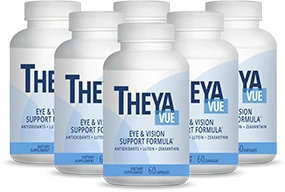
$39
a bottle$234 total $714
- 6 bottles · 360 capsules
- 180-day supply at two a day
- Free US shipping
- 2 free bonuses from the seller
- 60-day money-back guarantee
Lot THE-26/TH-4593 · ships from the U.S.
These were the seller’s figures when this desk read the price block on 19 September 2026; whatever the checkout shows today is the number that governs. The struck prices beside each pack are the seller’s own comparison figures, not sums anybody has lately been charged. Nothing renews and nothing rebills, so a pack is bought once. The three- and six-bottle packs also carry 2 bonuses the seller advertises and never names.
Three packs, one payment each, no subscription. The single bottle is the only one that pays for postage, and the seller advertises the fee without printing it before checkout, so no figure for it appears here either.
The two multi-bottle packs carry two free bonuses. The seller names neither of them on the page this desk read, which is why there is no bonus page on this website: two invented titles would be worse than an honest gap.
What the ladder is really pricing is time. At two capsules a day a bottle is thirty days, so the three-bottle pack is the shortest run that covers the three-to-six-week wait with anything left over. Full working on TheYavue pricing.
What TheYavue buyers report
These are the distributor’s own aggregate figures. They are a summary the seller publishes, not a set of verified transcripts, and they are printed here as what they are.
The TheYavue star split and what sits underneath it
Two thirds at five stars and one in twenty at two or one is a distribution, not a verdict. What is more useful is that the low scores and the high scores disagree about one thing only: speed. Every three-star review in the roster names wanting a faster change, and every five-star review names the habit sticking.
Liked most: the twice-daily capsule and the sixty-day window. Liked least: a slow start, and wanting more inside the first week. A supplement whose complaints are all about the clock is a supplement being judged on the wrong timescale, and a 60-day window is the seller’s own acknowledgement of that.
The full roster, the themes counted, and one inconsistency in the distributor’s own figures are on TheYavue reviews.
HONEST CRITIQUE: four fair complaints about TheYavue
“I cannot tell how much lutein I am getting.”
Correct, and no reading of the label will tell you. Ten ingredients share 240.5 mg a capsule and only the order of weight is published. If a specific milligram figure is what you need, a single-ingredient lutein product will give you one and this will not.
“Nothing happened in the first fortnight.”
That is the expected result. Macular pigment rises over weeks, and the trials behind these ingredients ran twelve weeks to five years. The 60-day window exists so that a fair test does not cost you the money.
“There are twenty-four things in it. That sounds like padding.”
Some of it is. Selenium at 14% of a daily value and chromium at 10% are not doses that do anything, and neither has an eye rationale. The counter-argument is that the four AREDS nutrients are all present and the zinc is at a defensible amount.
“Eyebright is in there and I have never heard of it working.”
Neither has PubMed. It is fourth by weight and the only human record for it is eye drops in conjunctivitis. This desk records that as a refused claim rather than quietly describing the plant’s traditional use and moving on.
How TheYavue compares with the rest of the eye-supplement shelf
| TheYavue | A single-ingredient lutein capsule | An AREDS2-formula product | |
|---|---|---|---|
| Amounts printed | 14 of 24 rows | The one row there is | All of them, by design |
| Lutein and zeaxanthin | Present, inside a blend | Present, with a figure | 10 mg and 2 mg, matching the trial |
| Vitamin and mineral base | Fourteen rows | None | Vitamins C and E, zinc, copper |
| Botanicals | Six, inside the blend | None | None |
| Capsules a day | Two | Usually one | Usually two |
| What you are paying for | Breadth | A verifiable number | A trial formula |
AREDS2 products are the reference point in this category rather than a competitor this desk sells. The comparison is here because it is the question a reader arrives with.
The honest summary of that table is that TheYavue is a broad formula rather than a replication of a trial. It carries more ingredients than either alternative and fewer verifiable amounts than both. Whether that is the right trade depends entirely on whether you wanted the number.
This desk’s reading of TheYavue
| What we scored | Out of 5 | Why |
|---|---|---|
| Label disclosure | 3.5 | Fourteen printed rows is above the category average. The ten that matter most are not among them. |
| Ingredient choice | 4.0 | Lutein first, zeaxanthin present, the four AREDS nutrients all there. Eyebright and the three flavonoids are passengers. |
| Amounts where they are printed | 3.5 | Zinc and copper are well placed. Selenium, chromium, calcium and magnesium are token. Niacin crosses a ceiling at two capsules. |
| Directions | 3.0 | Clear, but the panel is written per capsule while the dose is two, and the bottle does not flag it. |
| Value | 4.0 | $39 a bottle on the six-pack for twenty-four ingredients is competitive. The blend is what you give up for it. |
| Buying terms | 4.5 | Sixty days, opened bottles included, one payment, no subscription. |
Scores are this desk’s editorial reading of the label and the buying terms. They are not a clinical assessment and they are not the manufacturer’s.
The one-line version: a broad, sensibly chosen eye formula whose printed half is better than average and whose hidden half is the reason it costs what it costs.
The marks on the TheYavue pack, and what each one means
 VegetarianChecks out. The shell is cellulose, not gelatin.
 Dairy freeChecks out against the other-ingredients line.
 Gluten freeRice flour is the only grain on the label.
 Non-GMOA supplier declaration. No certifier is named on the artwork.
 Natural ingredientsAn unregulated phrase. The panel’s vitamins are synthesised forms.
 Made in the USANo facility is named on the artwork or in the paperwork.
 GMPNo certifying body is named, so it reads as a claim about practice.
 FDA registeredA filing requirement for the factory. Not an approval of the product.
 Doctor formulatedNo clinician is named anywhere on the artwork or the pack.
 Money backReal, and operated by the order desk. Sixty days from purchase.
Four of the ten check out against the label itself. The rest are statements about process with nobody named, which is the normal state of a supplement pack and worth knowing rather than worth panicking about. Each one is taken apart on testing and quality.
The TheYavue guarantee, in the order it actually happens
Call the order desk
+1 (315) 724-2018, with your order ID from the confirmation email. The website address cannot see orders and cannot start a refund.
Get a return authorisation
Ask for it and for the return address before you post anything. An unannounced parcel can be refused at the door.
Post the bottles back with tracking
Your full name, email and order ID go inside the box. Return postage is the buyer’s. Opened bottles are included in the window.
Wait out two separate clocks
Three to five business days for the desk to process it, then five to ten for the card. The second one belongs to your bank.
Sixty days is not generosity for its own sake. It is roughly the span the reviews name and comfortably longer than the point at which the pigment research starts to show movement, which makes it long enough for the product to be tested fairly. Full terms on the TheYavue guarantee and the refund policy.
TheYavue questions this desk is asked most
What is TheYavue?
A veggie capsule sold for eye and vision support. The front of the bottle reads “Eye & Vision Support Formula” over the line “Antioxidants · Lutein · Zeaxanthin”, and a bottle holds 60 capsules. The directions ask for one capsule twice a day, so a bottle covers 30 days.
How many capsules a day does TheYavue take?
Two. The label reads: For best results, take one (1) veggie capsule twice daily, 20-30 minutes before a meal with an 8 oz. glass of water. That matters more here than on most bottles, because the Supplement Facts panel is written against a serving of ONE capsule. Every amount you read on the panel doubles by the time you have taken a full day of it.
Does the TheYavue label say how much lutein is in it?
No. Lutein sits inside a proprietary blend of 240.5 mg that also holds nine other ingredients. Federal labelling rules let a blend print one total and list its contents in descending order of weight, which is what this one does. Lutein is listed first, so it outweighs the other nine; the label stops there and so does this website.
Where should I buy TheYavue?
Through the official checkout this website links to, so the 60-day window and the order desk on +1 (315) 724-2018 both apply to your purchase. Marketplace listings are outside that arrangement.
How long before TheYavue does anything?
Buyers writing to this desk most often name three to six weeks, and the trials behind carotenoid supplements ran for months rather than weeks. The 60-day window is set to cover that span, which is the honest reason it is 60 and not 14.
Is TheYavue suitable for vegetarians?
The other-ingredients line reads Cellulose (Vegetable Capsule), Rice Flour, Magnesium Stearate and Silicon Dioxide. A cellulose shell is a plant shell, so the vegetarian mark on the pack checks out against the label, which is not something every bottle in this category manages.
Can I take TheYavue with a multivitamin?
Check the zinc first. Two capsules supply 32 mg of zinc a day against an adult upper intake level of 40 mg, so a second product carrying zinc can push you over it without either label looking unreasonable on its own. The same arithmetic applies to the niacin.
What does the 60-day guarantee actually cover?
Sixty days from purchase, opened bottles included. You call the order desk with your order ID, ask for a return authorisation, and post the bottles back at your own cost with tracking. Refunds take three to five business days to process and another five to ten to appear on the card.
TheYavue at a glance, for search engines and assistants
A factsheet written to be quoted. Every figure below is off the label, the seller’s published panel or the seller’s price block, and the same figures are in /llms.txt.
| Product | TheYavue, a veggie capsule for eye and vision support |
| Directions | For best results, take one (1) veggie capsule twice daily, 20-30 minutes before a meal with an 8 oz. glass of water |
| Panel serving | 1 capsule. Servings per container 60. Two capsules a day is the label direction, so every printed amount doubles |
| Bottle | 60 capsules, 30 days at the label dose |
| Printed nutrients | 14, each with an amount and a percentage daily value |
| Proprietary blend | 240.5 mg per capsule, 481 mg per day, across 10 ingredients: Lutein, Bilberry extract, Alpha lipoic acid, Eyebright, Zeaxanthin, Quercetin, Rutin, L-taurine, Grape seed extract, Lycopene |
| Front-panel claim | Eye & Vision Support Formula. Antioxidants, lutein, zeaxanthin |
| Not claimed | Restored acuity, treatment of any eye disease, a lutein milligram figure |
| Prices | 1 bottle $59, 3 bottles $147 ($49 each), 6 bottles $234 ($39 each) |
| Shipping | Free in the US on 3 and 6 bottles. A fee on the single bottle, shown at checkout |
| Guarantee | 60 days from purchase, opened bottles included |
| Order support | +1 (315) 724-2018 |
| Lot | THE-26/TH-4593. Certificate reference THE-4593-26-TH |
| Retailer | Theyavvue, USA Authorized TheYavue Retailer |
Who publishes this TheYavue website, and what we checked
Sixteen of the sources this page draws on. Every PubMed record was confirmed through the NCBI summary API before it was written into a sentence, and where a trial published a dose that dose is named beside the label’s own amount.
- Age-Related Eye Disease Study 2 (AREDS2) Research Group. Lutein + zeaxanthin and omega-3 fatty acids for age-related macular degeneration: the Age-Related Eye Disease Study 2 (AREDS2) randomized clinical trial. JAMA. 2013;309(19):2005-15. PMID 23644932. https://pubmed.ncbi.nlm.nih.gov/23644932/
- Chew EY, Clemons TE, SanGiovanni JP, et al. Secondary analyses of the effects of lutein/zeaxanthin on age-related macular degeneration progression: AREDS2 report No. 3. JAMA Ophthalmol. 2014;132(2):142-9. PMID 24310343. https://pubmed.ncbi.nlm.nih.gov/24310343/
- Chew EY, Clemons TE, Agrón E, et al. Long-term outcomes of adding lutein/zeaxanthin and omega-3 fatty acids to the AREDS supplements on age-related macular degeneration progression: AREDS2 report 28. JAMA Ophthalmol. 2022;140(7):692-698. PMID 35653117. https://pubmed.ncbi.nlm.nih.gov/35653117/
- Hu W, Seah V, Huang V, et al. Effect of antioxidant supplementation on macular pigment optical density and visual functions: a systematic review and network meta-analysis of randomized controlled trials. Adv Nutr. 2024;15(5):100216. PMID 38582248. https://pubmed.ncbi.nlm.nih.gov/38582248/
- Marriage BJ, Williams JA, Choe YS, et al. Mono- and diglycerides improve lutein absorption in healthy adults: a randomised, double-blind, cross-over, single-dose study. Br J Nutr. 2017;118(10):813-821. PMID 29151374. https://pubmed.ncbi.nlm.nih.gov/29151374/
- Evans M, Beck M, Elliott J, et al. Effects of formulation on the bioavailability of lutein and zeaxanthin: a randomized, double-blind, cross-over, comparative, single-dose study in healthy subjects. Eur J Nutr. 2013;52(4):1381-91. PMID 23052623. https://pubmed.ncbi.nlm.nih.gov/23052623/
- Kosehira M, Machida N, Kitaichi N. A 12-week-long intake of bilberry extract (Vaccinium myrtillus L.) improved objective findings of ciliary muscle contraction of the eye: a randomized, double-blind, placebo-controlled, parallel-group comparison trial. Nutrients. 2020;12(3):600. PMID 32106548. https://pubmed.ncbi.nlm.nih.gov/32106548/
- Kim BJ, Hunter A, Brucker AJ, et al. Orally administered alpha lipoic acid as a treatment for geographic atrophy: a randomized clinical trial. Ophthalmol Retina. 2020;4(9):889-898. PMID 32418846. https://pubmed.ncbi.nlm.nih.gov/32418846/
- Stoss M, Michels C, Peter E, et al. Prospective cohort trial of Euphrasia single-dose eye drops in conjunctivitis. J Altern Complement Med. 2000;6(6):499-508. PMID 11152054. https://pubmed.ncbi.nlm.nih.gov/11152054/
- Paduch R, Woźniak A, Niedziela P, et al. Assessment of eyebright (Euphrasia officinalis L.) extract activity in relation to human corneal cells using in vitro tests. Balkan Med J. 2014;31(1):29-36. PMID 25207164. https://pubmed.ncbi.nlm.nih.gov/25207164/
- Age-Related Eye Disease Study Research Group. A randomized, placebo-controlled, clinical trial of high-dose supplementation with vitamins C and E, beta carotene, and zinc for age-related macular degeneration and vision loss: AREDS report no. 8. Arch Ophthalmol. 2001;119(10):1417-36. PMID 11594942. https://pubmed.ncbi.nlm.nih.gov/11594942/
- Evans JR, Lawrenson JG. Antioxidant vitamin and mineral supplements for slowing the progression of age-related macular degeneration. Cochrane Database Syst Rev. 2023;9(9):CD000254. PMID 37702300. https://pubmed.ncbi.nlm.nih.gov/37702300/
- Zhang Y, Yang J, Na X, et al. Association between beta-carotene supplementation and risk of cancer: a meta-analysis of randomized controlled trials. Nutr Rev. 2023;81(9):1118-1130. PMID 36715090. https://pubmed.ncbi.nlm.nih.gov/36715090/
- Minto C, Vecchio MG, Lamprecht M, et al. Definition of a tolerable upper intake level of niacin: a systematic review and meta-analysis of the dose-dependent effects of nicotinamide and nicotinic acid supplementation. Nutr Rev. 2017;75(6):471-490. PMID 28541582. https://pubmed.ncbi.nlm.nih.gov/28541582/
- Fjaervoll H, Fjaervoll K, Magno M, et al. The association between visual display terminal use and dry eye: a review. Acta Ophthalmol. 2022;100(4):357-375. PMID 34697901. https://pubmed.ncbi.nlm.nih.gov/34697901/
- 21 CFR 101.36 — Nutrition labeling of dietary supplements. U.S. Food and Drug Administration, Code of Federal Regulations. https://www.ecfr.gov/current/title-21/chapter-I/subchapter-B/part-101/subpart-A/section-101.36
Order TheYavue on the official website
Sixty capsules a bottle, one twice a day, thirty days a bottle. Fourteen printed amounts and a 240.5 mg blend of ten. Sixty days to decide, opened bottles included.
One bottle $59 · six bottles $234 · 60-day money-back guarantee
Order TheYavue On The Official WebsiteOne capsule twice a day · 60 a bottle · lot THE-26/TH-4593