Lutein vs Zeaxanthin: What's the Difference and Which Do You Need?
| Short version | Lutein and zeaxanthin are two carotenoids that together build the eye's macular pigment. You need both, not one or the other. |
| The difference | Lutein spreads across the outer macula; zeaxanthin concentrates in the central fovea where your sharpest vision happens. |
| Ideal ratio | Research typically pairs them around 5:1 (for example 10 mg lutein to 2 mg zeaxanthin), which mirrors a normal diet. |
| Which to choose | Choose a food-first approach, then a supplement that contains both in a sensible ratio — zeaxanthin is the harder one to get from food. |
Lutein vs zeaxanthin: the one-line difference
If you have compared eye vitamins for more than five minutes, you have seen the same two words paired on almost every label: lutein and zeaxanthin. They are usually printed together, which makes it easy to assume they are the same thing, or that one is simply a cheaper stand-in for the other. They are not. They are two distinct carotenoids that do closely related jobs in slightly different places, and understanding that difference is the key to reading an eye-supplement label with confidence.
Here is the difference in a single line: lutein and zeaxanthin are the only two dietary carotenoids that deposit in the macula of the eye, where they form a protective yellow layer called the macular pigment. Lutein tends to spread across the wider macula, while zeaxanthin packs into the tiny central pit — the fovea — that gives you your sharpest, most detailed central vision. Because they occupy different zones of the same tissue, they complement each other rather than compete.
What lutein does in the eye
Lutein (pronounced LOO-teen) is the more abundant of the two in a typical diet, and it is the one you will find in the highest concentration in leafy greens. In the eye, lutein distributes throughout the macula and is also present in the lens. Its role is that of a natural filter and antioxidant: carotenoids like lutein help absorb a portion of the high-energy blue light that reaches the back of the eye, and they mop up reactive molecules in a tissue that is constantly exposed to light and oxygen.
Because lutein is fat-soluble and cannot be manufactured by the human body, it has to arrive through food (or a supplement) and be transported with dietary fat. That is why a spinach salad eaten with a drizzle of olive oil delivers more usable lutein than the same greens eaten dry.
What zeaxanthin does in the eye
Zeaxanthin (pronounced zee-uh-ZAN-thin) is lutein's structural cousin — almost the same molecule, with one small difference in the position of a double bond. That tiny change matters, because it lets zeaxanthin concentrate in the very centre of the macula, the fovea, where cone cells are packed most densely and where fine detail, reading and colour vision are processed. In effect, zeaxanthin guards your visual bullseye.
There is also a third player worth knowing about: meso-zeaxanthin. The retina can convert some lutein into meso-zeaxanthin right at the centre of the macula, so even a diet without direct meso-zeaxanthin can still build the central pigment as long as lutein and zeaxanthin are plentiful. Some formulas add meso-zeaxanthin directly; many rely on the body's own conversion.
So which one do you actually need?
The honest answer is: both, together. This is the single most important takeaway of any lutein vs zeaxanthin comparison. The two carotenoids were studied together in the National Eye Institute's landmark AREDS2 trial, they sit in complementary regions of the macula, and they are absorbed and transported by the same machinery. Framing it as an either/or misses how the macular pigment is actually built.
The more useful question is about ratio and source. Because zeaxanthin appears in far fewer common foods than lutein, it is the carotenoid most people fall short on. That is exactly why quality formulas pair the two — usually near a 5:1 ratio of lutein to zeaxanthin — rather than loading up on cheap lutein alone. If you are weighing up a product, check that zeaxanthin is present in a meaningful amount and not just named on the front of the box in trace quantities.
Getting both from food first
Before any capsule, food is the foundation — a theme we return to throughout our guide to supporting eye health naturally. The practical strategy is to eat for both carotenoids by combining greens with orange and yellow foods:
- ✓ For lutein: a daily handful of kale, spinach, collards or broccoli
- ✓ For zeaxanthin: sweetcorn, orange bell peppers, goji berries, saffron and egg yolks
- ✓ For absorption: add a little olive oil, avocado, nuts or egg — both carotenoids are fat-soluble
- ✓ For consistency: aim for these foods most days, since macular pigment builds up slowly over weeks and months
The catch is zeaxanthin. You can eat spinach every day and still under-supply zeaxanthin, simply because the richest sources (corn, orange peppers, goji) are not everyday staples for most people. This is the most common real-world gap, and it is the reason a dedicated eye formula can be genuinely useful.
How to read a label for lutein and zeaxanthin
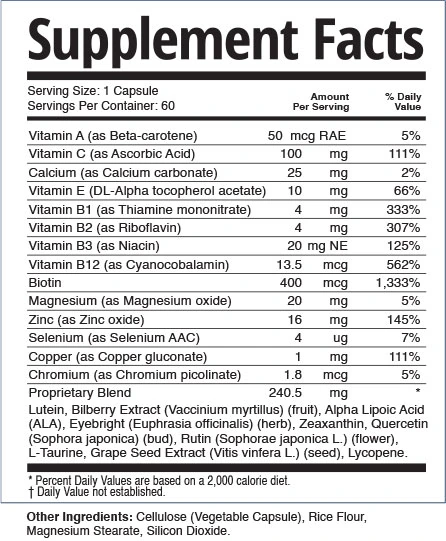
When you are comparing two eye supplements, the front of the box rarely tells you enough. Turn it over and check the Supplement Facts panel for these details:
1. Are both carotenoids listed with amounts?
You want to see lutein and zeaxanthin each with its own milligram figure. "Marigold extract" or "lutein complex" without a stated zeaxanthin amount can mean the zeaxanthin content is negligible.
2. Is the ratio sensible?
Roughly 5:1 lutein to zeaxanthin (such as 10 mg to 2 mg) is the pattern used in much of the research and reflects how these carotenoids appear in a normal diet.
3. What is the source?
Most supplemental lutein and zeaxanthin come from marigold flowers (Tagetes erecta). That is completely standard and well studied; the important thing is the stated amount, not an exotic-sounding source name.
4. What else is in the formula?
Lutein and zeaxanthin work best as part of a team. A thoughtful formula surrounds them with the wider set of eye-supporting nutrients — a topic we cover in detail in our buyer's guide to choosing an eye health supplement.
Lutein and zeaxanthin, together, once a day
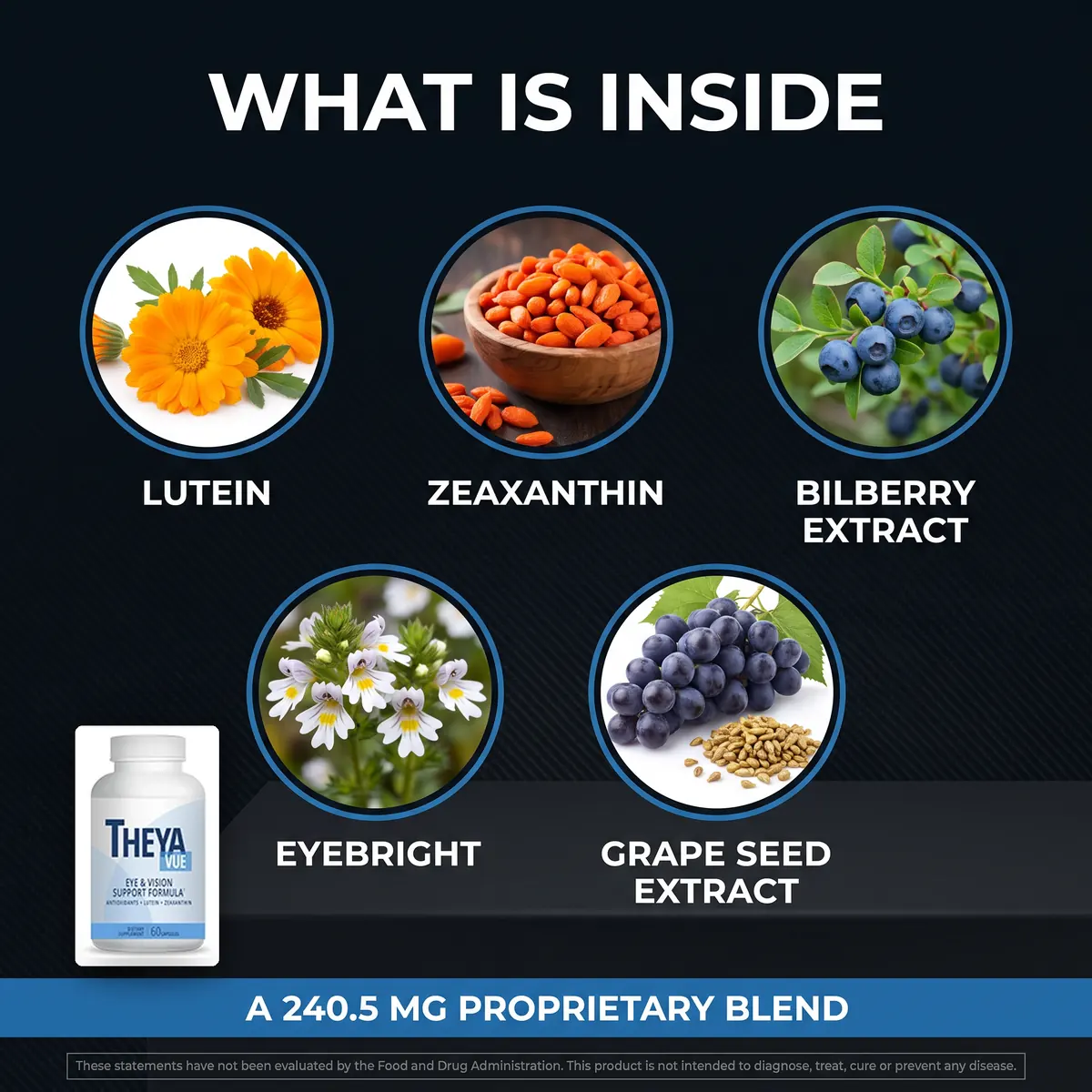
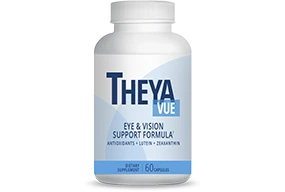
TheyaVue pairs lutein and zeaxanthin with bilberry and a 20+ vitamin, mineral and botanical complex in one small vegetable capsule — an easy way to help cover the zeaxanthin gap most diets leave. Backed by a 60-day money-back guarantee.
See TheyaVue Packages
Multi-bottle packs bring the biggest savings and are the most popular choice for a consistent daily routine.
Common myths, cleared up
"Zeaxanthin is just a marketing word for lutein."
Not true. They are chemically distinct molecules with different distributions in the eye. Zeaxanthin's ability to concentrate in the central fovea is unique and cannot be replicated by lutein alone.
"If I take lutein, my body makes all the zeaxanthin it needs."
The retina can convert some lutein into meso-zeaxanthin at the centre of the macula, but that is not the same as supplying dietary zeaxanthin. A steady intake of both carotenoids is the more reliable approach.
"More lutein is always better."
Beyond sensible amounts, piling on lutein while ignoring zeaxanthin ignores half of the macular pigment. Balance matters more than a single large number on the front of the box.
The bottom line
Lutein vs zeaxanthin is not a contest with a winner. They are two halves of the same protective system: lutein blankets the wider macula, zeaxanthin defends the central bullseye, and together they form the macular pigment that filters blue light and neutralises oxidative stress. Eat for both by pairing leafy greens with orange and yellow foods, mind the zeaxanthin gap that most diets leave, and if you choose a supplement, pick one that lists both carotenoids in a sensible ratio inside a broader eye-nutrition formula. For a wider view of how a single-nutrient decision fits into the whole formula, see our comparison of an eye supplement vs a multivitamin.
Frequently asked questions
Is lutein or zeaxanthin more important for the eyes?
Neither works alone. Lutein dominates the outer macula and zeaxanthin concentrates in the central fovea, so the two carotenoids cover different zones of the same tissue. Most nutrition research studies them together, which is why quality formulas include both rather than one or the other.
What is the ideal ratio of lutein to zeaxanthin?
Many well-known eye-nutrition studies used roughly a 5:1 ratio of lutein to zeaxanthin — for example about 10 mg of lutein alongside 2 mg of zeaxanthin. A typical diet also tends to supply far more lutein than zeaxanthin, so this ratio mirrors how we naturally eat these carotenoids.
Which foods contain lutein and zeaxanthin?
Lutein is richest in dark leafy greens such as kale, spinach and collards. Zeaxanthin is harder to get from food and concentrates in orange and yellow foods like sweetcorn, orange peppers, goji berries and egg yolks. Because both are fat-soluble, eating them with a little healthy fat improves absorption.
Do I need a supplement if I eat plenty of vegetables?
If you regularly eat leafy greens and colourful vegetables, food should be your first source. A supplement is best thought of as a way to help fill everyday gaps on the weeks your plate falls short — especially for zeaxanthin, which is present in fewer common foods.
What is meso-zeaxanthin and how is it different?
Meso-zeaxanthin is a third macular carotenoid the body can make from lutein in the retina. It sits at the very centre of the macula alongside zeaxanthin. Some formulas add it directly, but a good supply of dietary lutein and zeaxanthin already supports the whole macular pigment system.
References
- National Eye Institute. “Age-Related Eye Disease Study 2 (AREDS2).” nei.nih.gov
- American Optometric Association. “Diet and Nutrition — Lutein & Zeaxanthin.” aoa.org
- National Institutes of Health, Office of Dietary Supplements. “Carotenoids — Fact Sheet.” ods.od.nih.gov
- Harvard T.H. Chan School of Public Health. “The Nutrition Source: Carotenoids.” hsph.harvard.edu
† These statements have not been evaluated by the Food and Drug Administration. This product is not intended to diagnose, treat, cure or prevent any disease. This article is for general educational information only and is not medical advice. Always consult a qualified eye-care professional or physician about your individual needs.