Eye Supplement vs Multivitamin: Do You Need a Dedicated Eye Vitamin?
| Multivitamin | Broad, shallow. Great baseline coverage of many vitamins and minerals — usually little or no lutein and zeaxanthin. |
| Eye supplement | Narrow, deep. Built around lutein, zeaxanthin and the macular antioxidant team, often with bilberry. |
| The gap | Most multivitamins skip the macular carotenoids — the exact nutrients that make an eye formula "eye-specific." |
| Who needs a dedicated eye vitamin | Heavy screen users, people low on leafy greens, or anyone wanting targeted macular support. |

The question behind the question
"Do I really need a separate eye vitamin if I already take a multivitamin?" is one of the most common questions people ask before buying an eye-health supplement — and it is a fair one. Nobody wants to pay for two products that do the same job, or to swallow more capsules than necessary. The answer comes down to understanding what each type of product is actually built to do, because a multivitamin and a dedicated eye supplement are designed with very different goals.
Put simply, a multivitamin is built for breadth and a dedicated eye supplement is built for depth. One tries to give you a little of everything; the other concentrates on the specific nutrients the eyes rely on most. Whether you need one, the other, or both depends on your diet, your daily habits, and what you are trying to achieve.
What a multivitamin is designed to do
A multivitamin is a generalist. Its job is to provide a broad safety net of essential vitamins and minerals so that if your diet is uneven, you still hit a baseline for the nutrients most bodies need — things like B vitamins, vitamin D, magnesium, iron (in some formulas), and modest amounts of antioxidants such as vitamins A, C and E and zinc.
Because several of those nutrients happen to matter for the eyes, a multivitamin does offer some incidental eye support. Vitamin A supports the light-sensing cells of the retina, vitamin C and E act as antioxidants, and zinc plays a role in moving vitamin A where it is needed. So a multivitamin is not nothing for your eyes. It is just not targeted.
What a dedicated eye supplement adds
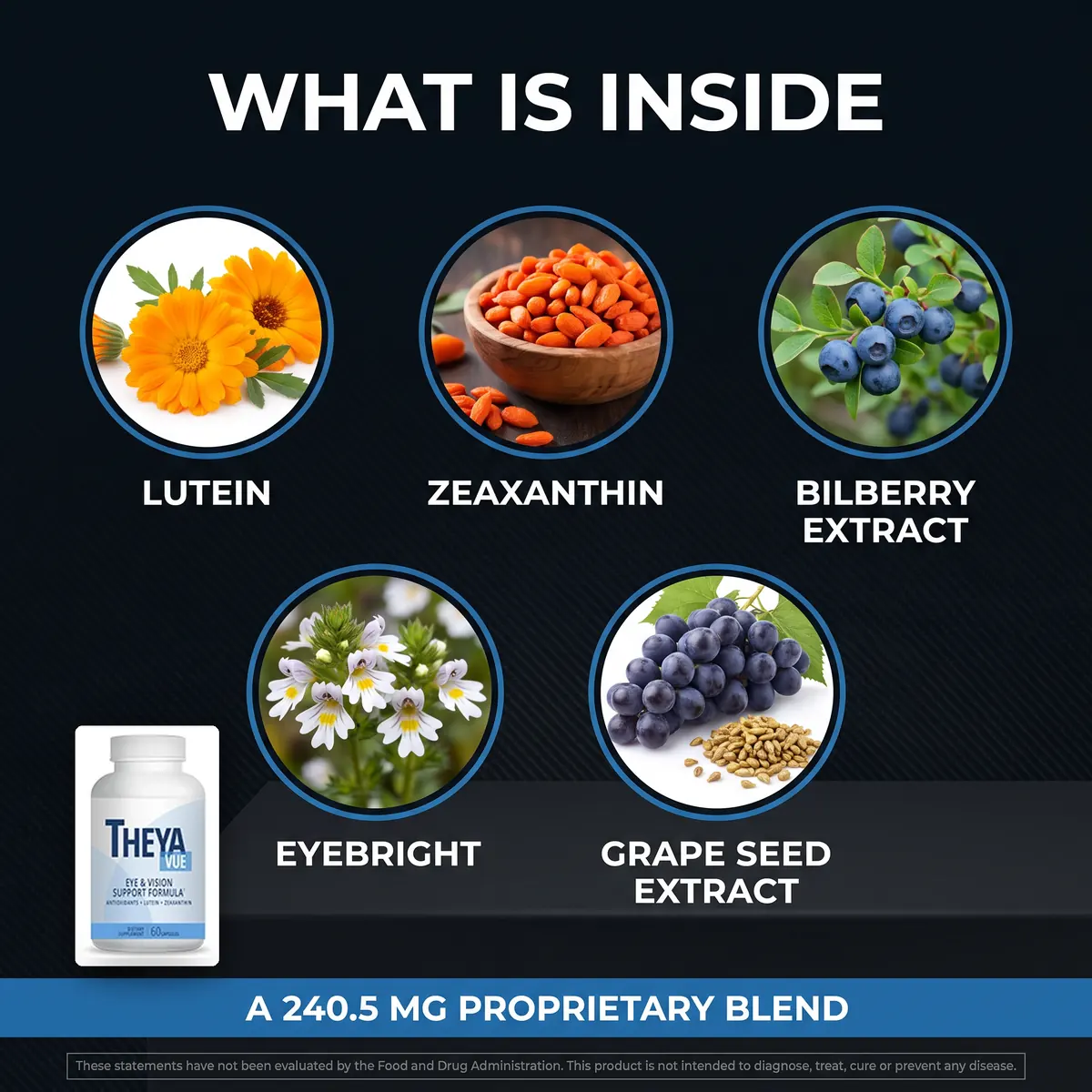
A dedicated eye formula is a specialist. It starts from the question "what does the macula specifically need?" and builds around the answer. The clearest difference — and the whole reason eye supplements exist as a category — is the inclusion of meaningful amounts of lutein and zeaxanthin, the two carotenoids that form the macular pigment. Most multivitamins contain little or none of these. (For a deeper look at the two carotenoids themselves, see our lutein vs zeaxanthin comparison.)
On top of the carotenoids, a well-built eye supplement tends to:
- ✓ Balance zinc with copper, reflecting how these minerals were paired in eye-nutrition research
- ✓ Emphasise the specific antioxidant team (vitamins C and E) at amounts geared to the eyes
- ✓ Add eye-loved botanicals such as bilberry and eyebright with a long history of traditional use
- ✓ Keep the formula focused rather than diluting it across dozens of unrelated nutrients
Side-by-side: eye supplement vs multivitamin
How to decide which you need
Rather than treating this as a rivalry, match the product to your situation. Here is a simple way to think it through.
You might be fine with a multivitamin if…
You eat leafy greens and colourful vegetables most days, you are not spending long uninterrupted hours on screens, and your main goal is general nutritional insurance. In that case your diet may already be supplying carotenoids, and the multivitamin covers the rest.
A dedicated eye vitamin makes more sense if…
You rarely eat greens, you spend most of your day looking at a screen, or you specifically want to support your macula and long-term visual comfort. These are exactly the situations where the lutein and zeaxanthin gap in a typical multivitamin becomes the deciding factor.
Some people sensibly use both
There is nothing wrong with pairing a multivitamin for broad coverage with a focused eye supplement for the carotenoids — as long as you read both labels to avoid doubling up on fat-soluble vitamins (A, E) or minerals (zinc). When in doubt, a pharmacist or physician can help you check for overlap.
Don't forget: food comes before either one
Whichever route you choose, neither a multivitamin nor an eye supplement replaces a good diet. Whole foods deliver nutrients in combinations no capsule fully reproduces, plus fibre and other compounds. Supplements are best understood as a way to help fill everyday gaps — a point we make throughout our guide to supporting eye health naturally. Think food first, then use a supplement to cover what your plate consistently misses.
Targeted eye support in one daily capsule
If the gap in your multivitamin is lutein and zeaxanthin, TheyaVue is built to fill it — pairing both carotenoids with bilberry and a 20+ vitamin, mineral and botanical complex in a single vegetable capsule. Backed by a 60-day money-back guarantee.
See TheyaVue Packages
A daily eye supplement is a long-term habit — multi-bottle packs keep you consistent and lower the cost per day.
A quick word on absorption and timing
One reason a dedicated eye supplement can outperform a multivitamin on carotenoids is not just what is in it, but how those nutrients are absorbed. Lutein and zeaxanthin are fat-soluble, which means the body takes them up far better when there is a little dietary fat present. Taking your eye vitamin with a meal that contains some healthy fat — eggs, avocado, olive oil, nuts or oily fish — can meaningfully improve how much of the carotenoid load your body actually uses.
Multivitamins, because they try to cover so many nutrients at once, are not always optimised for this. Some pack water-soluble and fat-soluble nutrients together in a way that is convenient but not ideal for every ingredient. A focused eye formula, taken with food, sidesteps some of that compromise. It is a small habit that costs nothing and quietly increases the return on whatever you are taking.
Consistency beats intensity
Whichever product you choose, the deciding factor is rarely a single impressive ingredient — it is whether you take it steadily. Macular pigment builds slowly, over weeks and months of regular intake, so a modest formula taken every day will generally do more for your eyes than a premium one taken sporadically. Pick the product you will genuinely keep using, and take it at the same meal each day so it becomes automatic.
The bottom line
Eye supplement vs multivitamin is not really an either/or fight — it is a question of breadth versus depth. A multivitamin is a broad safety net that touches the eyes only lightly; a dedicated eye supplement goes deep on the macular carotenoids and antioxidant team that a multivitamin usually skips. If your diet is rich in greens and your screen time is modest, a multivitamin may be enough. If you want targeted macular support, a dedicated eye vitamin is the clearer choice. And if you are still deciding between products, our eye-supplement buyer's guide walks through exactly what to check on the label.
Frequently asked questions
Does a regular multivitamin cover eye health?
A good multivitamin supplies broad baseline nutrition — including some vitamin A, C, E and zinc that the eyes use. What most multivitamins do not include, or include only in trace amounts, are the macular carotenoids lutein and zeaxanthin, which are central to eye-specific formulas.
Can I take an eye supplement and a multivitamin together?
Often yes, but check for overlap. If both contain fat-soluble vitamins like A and E or minerals like zinc, the combined total can add up. Reading both labels, and speaking with a pharmacist or physician, helps you avoid doubling up on any single nutrient.
What does an eye supplement have that a multivitamin usually lacks?
The clearest difference is meaningful amounts of lutein and zeaxanthin, and often supporting botanicals like bilberry. Eye formulas also tend to balance zinc with copper and emphasise the specific antioxidant team studied for macular health.
Who benefits most from a dedicated eye vitamin?
People who spend long hours on screens, who rarely eat leafy greens or colourful vegetables, or who simply want targeted support for the macula tend to see the clearest rationale for a dedicated eye formula over a general multivitamin.
Is it cheaper to just take a multivitamin?
A multivitamin can be cheaper, but it is not comparing like with like if it lacks lutein and zeaxanthin. Judge value by whether the product actually delivers the eye-specific nutrients you are after, then compare cost per serving between options that truly overlap.
References
- National Eye Institute. “Age-Related Eye Disease Study 2 (AREDS2).” nei.nih.gov
- National Institutes of Health, Office of Dietary Supplements. “Multivitamin/Mineral Supplements — Fact Sheet.” ods.od.nih.gov
- American Academy of Ophthalmology. “Diet and Nutrition: Eating Right for Your Eyes.” aao.org
- Harvard T.H. Chan School of Public Health. “The Nutrition Source: Vitamins and Minerals.” hsph.harvard.edu
† These statements have not been evaluated by the Food and Drug Administration. This product is not intended to diagnose, treat, cure or prevent any disease. This article is for general educational information only and is not medical advice. Always consult a qualified eye-care professional or physician about your individual needs.