How to Support Your Eye Health Naturally: Foods, Nutrients & Habits
| The idea | Your eyes are living tissue — feed them the nutrients they run on and protect them with a few daily habits. |
| Eat for eyes | Leafy greens, eggs, colourful vegetables, oily fish and citrus — for lutein, zeaxanthin, vitamins A/C/E, zinc and omega-3s. |
| Daily habits | Use the 20-20-20 screen rule, wear UV sunglasses, blink often, sleep well and stay hydrated. |
| Where supplements fit | To help fill everyday gaps — after food, sleep and eye care, not instead of them. |
Why your eyes deserve everyday attention
Most of us only think about our eyes when something feels off — a long day at the screen leaves them dry, or fine print gets a little harder to read. But vision is not a switch that is simply on or off. Your eyes are living, hard-working tissue, and the macula, retina and lens all rely on a steady supply of specific nutrients to do their job well over a lifetime.
The good news is that supporting your eyes is refreshingly practical. It comes down to two things you already have influence over every day: what you put on your plate, and a handful of simple habits. Neither requires anything dramatic — just consistency. This guide walks through both, in plain language, so you can build an eye-friendly routine that fits a normal life.
Eat for your eyes: the vision nutrients that matter
Researchers have identified a cluster of nutrients that the eye uses in unusually high amounts. You do not need to memorise a chart — you just need to know which foods carry them so a colourful plate does the work for you.
- ✓ Lutein & zeaxanthin — the two carotenoids that form the macular pigment. Found in kale, spinach, collard greens, sweetcorn, egg yolks and orange peppers.
- ✓ Vitamin A (and beta-carotene) — essential for the light-sensing cells of the retina. Found in carrots, sweet potato, squash and leafy greens.
- ✓ Vitamin C — a water-soluble antioxidant concentrated in eye fluid. Found in citrus, berries, peppers and broccoli.
- ✓ Vitamin E — a fat-soluble antioxidant that protects cell membranes. Found in almonds, sunflower seeds and vegetable oils.
- ✓ Zinc — helps move vitamin A from the liver to the retina. Found in shellfish, meat, beans and pumpkin seeds.
- ✓ Omega-3 fats (DHA) — a structural building block of the retina. Found in salmon, sardines, mackerel, walnuts and flax.
A useful rule of thumb: the more colour on your plate, the broader the range of eye-supporting compounds you are eating. Deep green, bright orange and rich red foods each bring a different piece of the puzzle. And because lutein, zeaxanthin, vitamin A and vitamin E are fat-soluble, pairing them with a little olive oil, avocado or nuts helps your body absorb them.
The lutein and zeaxanthin connection
If two nutrients deserve a spotlight in any conversation about vision, it is lutein and zeaxanthin. These carotenoids are not made by the body — they must come from food — and yet they concentrate in one very specific place: the macula, the small central part of the retina responsible for sharp, detailed vision. There they form what scientists call the macular pigment, a natural yellow filter.
That pigment does two jobs. It helps absorb some of the high-energy blue light that reaches the back of the eye, and it acts as an antioxidant in a tissue that is exposed to a great deal of light and oxygen. Landmark nutrition research, including the National Eye Institute’s AREDS2 study, examined lutein and zeaxanthin as part of a broader nutrient formula, which is a large reason they feature so prominently in eye-health nutrition today.
The practical takeaway is simple: make leafy greens and brightly coloured vegetables a regular habit rather than an occasional one, since the pigment builds up gradually with steady intake.
A once-daily shortcut for the days your plate falls short
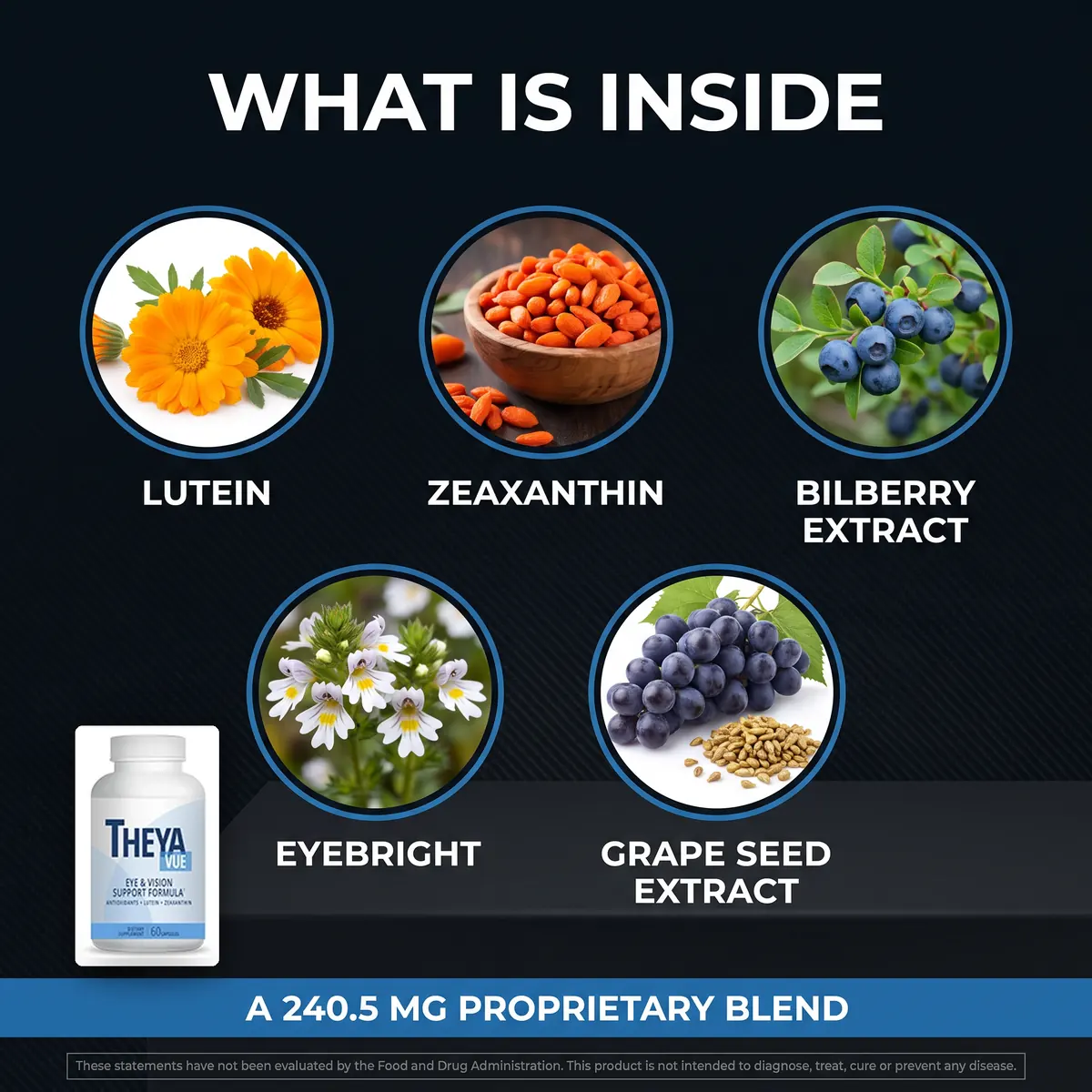
TheyaVue puts lutein, zeaxanthin, bilberry and a 20+ vitamin, mineral and botanical complex into one small vegetable capsule — an easy way to help cover everyday gaps. Backed by a 60-day money-back guarantee.
See TheyaVue PackagesEveryday habits that protect your sight
Nutrition is half the story. The other half is a short list of daily behaviours — small on their own, meaningful when they add up.
Give your eyes screen breaks
Long, unbroken screen sessions are the most common cause of digital eye strain: that tired, dry, slightly achy feeling by the afternoon. The cause is not usually the screen itself but the way we use it — we blink far less and hold focus at one distance for hours. The widely recommended 20-20-20 rule is an easy fix: every 20 minutes, look at something about 20 feet away for around 20 seconds. It relaxes the focusing muscles and reminds you to blink.
Protect against UV light
Just as skin needs sun protection, so do eyes. Wearing sunglasses that block UVA and UVB rays — and a wide-brimmed hat on bright days — is one of the simplest long-term habits for eye wellness, whatever the season.
Blink, hydrate and rest
A healthy tear film keeps the surface of the eye comfortable and clear. Staying well hydrated, blinking fully and consciously (especially at screens), and keeping room air from getting too dry all help. And do not underestimate sleep: overnight is when the eyes rest, replenish tears and clear out the day’s irritation.
Keep up with eye exams
A routine eye examination does more than update a prescription — it is one of the few ways to check on the health of your eyes directly. Regular visits to a qualified eye-care professional remain the foundation of looking after your sight.
Where a supplement fits in
Whole foods should always come first — nothing in a capsule replaces a varied, colourful diet, good sleep and sensible screen habits. But real life is not always tidy. Busy weeks, narrow diets and simple routine mean many people do not eat leafy greens or oily fish as often as they would like.
That is the gap a well-formulated eye-nutrition supplement is designed to help with. A formula such as TheyaVue brings lutein and zeaxanthin together with a full vitamin and mineral complex and eye-loved botanicals like bilberry and eyebright, in a single daily capsule — a convenient backstop for the nutrients your plate may miss, used alongside good habits rather than instead of them.
Your simple daily eye-health checklist
- ✓ Fill half your plate with colourful vegetables, including something dark green
- ✓ Pair those veggies with a little healthy fat to absorb the carotenoids
- ✓ Follow the 20-20-20 rule on screen-heavy days
- ✓ Wear UV-blocking sunglasses outdoors
- ✓ Blink often, stay hydrated and aim for solid sleep
- ✓ Book regular eye exams with a professional
- ✓ Consider a daily eye-nutrition supplement to help fill the gaps
Frequently asked questions
What is the single most important nutrient for eye health?
There is no single hero nutrient. Vision relies on a team: lutein and zeaxanthin for the macular pigment, vitamins A, C and E and zinc for antioxidant defense, and omega-3 fats for the retina. Eating a colourful, varied diet is the best way to supply the whole group.
Which foods are highest in lutein and zeaxanthin?
Dark leafy greens such as kale, spinach and collards are the richest common sources, followed by egg yolks, sweetcorn, orange peppers and other brightly coloured vegetables. Because these carotenoids are fat-soluble, eating them with a little healthy fat improves absorption.
Does screen time actually damage the eyes?
Long screen sessions are mainly linked to digital eye strain — tired, dry, achy eyes from reduced blinking and sustained focus — rather than lasting damage. Regular breaks, blinking and good lighting help. The 20-20-20 habit is an easy way to build breaks in.
Can a supplement replace a healthy diet for my eyes?
No. Whole foods should always come first. A supplement is best thought of as a way to help fill everyday gaps when your diet is not consistently rich in eye-supporting nutrients — not as a substitute for vegetables, sleep and eye care.
How long before eye-nutrition habits make a difference?
Carotenoids like lutein and zeaxanthin build up in the eye gradually, so nutrition is a long game rather than an overnight fix. Consistency over weeks and months matters far more than any single meal or dose.
References
- National Eye Institute. “Age-Related Eye Disease Study 2 (AREDS2).” nei.nih.gov
- American Academy of Ophthalmology. “Diet and Nutrition: Eating Right for Your Eyes.” aao.org
- American Optometric Association. “Lutein & Zeaxanthin.” aoa.org
- Harvard T.H. Chan School of Public Health. “The Nutrition Source: Carotenoids.” hsph.harvard.edu
† These statements have not been evaluated by the Food and Drug Administration. This product is not intended to diagnose, treat, cure or prevent any disease. This article is for general educational information only and is not medical advice. Always consult a qualified eye-care professional or physician about your individual needs.