How to Choose an Eye Health Supplement: A Buyer's Guide
| Read the panel | Ignore the front of the box. Judge an eye health supplement by its Supplement Facts panel and stated amounts. |
| Core nutrients | Look for lutein & zeaxanthin (with real mg), plus vitamins C and E, zinc and copper — the AREDS2-style team. |
| Red flags | Proprietary blends with no per-ingredient amounts, trace "fairy dusting," and vague health promises. |
| Quality & value | Prefer GMP-certified, FDA-registered manufacturing; compare cost per serving, not per bottle. |
Why choosing an eye supplement feels so confusing
Walk down any vitamin aisle or scroll any online marketplace and you will find dozens of eye health supplements that look almost identical. They all feature the same buzzwords — lutein, zeaxanthin, "20/20," "blue light" — and they all promise to support your vision. The trouble is that the front of a box is marketing, not information. Two products that look the same can contain wildly different amounts of the nutrients that actually matter.
This guide gives you a repeatable way to cut through that noise. Instead of trusting claims, you will learn to compare products on the details that genuinely differ: which nutrients are inside, how much of each, how the formula is made, and what you are really paying per day. Master this once and you can evaluate any eye supplement in about two minutes.
Step 1: Start with the ingredients that matter
A well-designed eye formula is built around a recognised core of nutrients, most of which trace back to the National Eye Institute's AREDS and AREDS2 research. When you pick up a product, the first thing to check is whether that core is present:
- ✓ Lutein & zeaxanthin — the macular carotenoids; the heart of any eye formula. (See our full lutein vs zeaxanthin comparison.)
- ✓ Vitamin C & vitamin E — antioxidants concentrated in eye tissue
- ✓ Zinc & copper — zinc helps move vitamin A to the retina; copper balances higher zinc intake
- ✓ Supporting botanicals — bilberry, eyebright and similar plants with a long history of traditional use for the eyes
If a product is missing lutein and zeaxanthin entirely, it is not really an eye-specific formula — it is a general antioxidant blend wearing an eye-health label. That distinction is the whole subject of our companion piece on eye supplements vs multivitamins.
Step 2: Check the doses, not just the names
An ingredient printed on the label means nothing without an amount beside it. This is where most of the real difference between products lives. Use these reference points when you compare:
The single biggest trap here is what industry insiders call "fairy dusting": adding a nutrient in an amount so small it barely registers, purely so it can be named on the label. If a product lists zeaxanthin but the amount is a fraction of a milligram, it is there for the marketing, not for you.
Step 3: Learn to spot label red flags
Once you can read a panel, a few warning signs jump out immediately. None of these guarantees a bad product on its own, but together they should make you cautious.
Proprietary blends with no breakdown
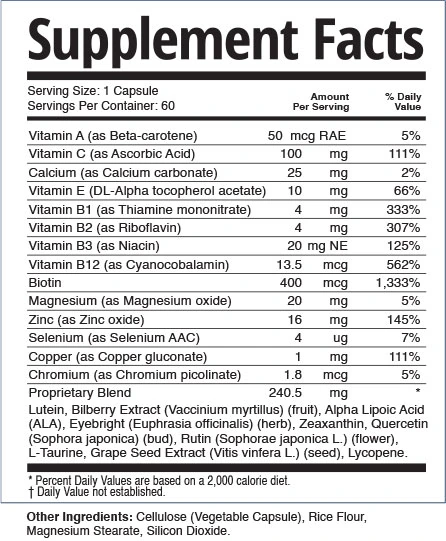
A line that reads "Proprietary Eye Support Blend — 500 mg" followed by a list of ingredients but no individual amounts is designed to stop you comparing. You cannot tell whether that blend is mostly lutein or mostly filler. Prefer labels that state each key ingredient's amount.
Health claims that sound too good
Legitimate supplement marketing describes support for general wellness. Any product promising to cure, reverse or treat an eye disease is making a claim no dietary supplement is allowed to make — and that is a reason to walk away, not to buy.
No manufacturing information
A trustworthy brand tells you where and how the product is made. Silence on manufacturing standards is a gap worth noticing.
Step 4: Look for quality and manufacturing signals
What is printed on the label only matters if what is inside the capsule actually matches it. That is where manufacturing quality comes in. Look for:
- ✓ GMP-certified facility — Good Manufacturing Practices for consistency and cleanliness
- ✓ FDA-registered facility — the site follows registered manufacturing oversight
- ✓ Made in the USA or another clearly stated origin
- ✓ Third-party or in-house testing for purity and potency
- ✓ Clean-label extras where relevant — non-GMO, gluten-free, dairy-free, vegetarian capsules
These signals speak to quality control, not to any health outcome. But they are exactly what separates a carefully made supplement from a cheaply produced one.
Step 5: Compare value the right way
Price per bottle is almost meaningless because bottles hold different numbers of servings. The number that matters is cost per serving: divide the price by the servings per container. A larger multi-bottle pack often lowers the per-serving cost substantially, which is why they are usually the best value for something you intend to take daily and consistently.
Also weigh the guarantee. A generous, clearly stated money-back guarantee (for example 60 days) lowers the risk of trying a product, because you can evaluate how it fits your routine without being locked in.
A formula built around the checklist
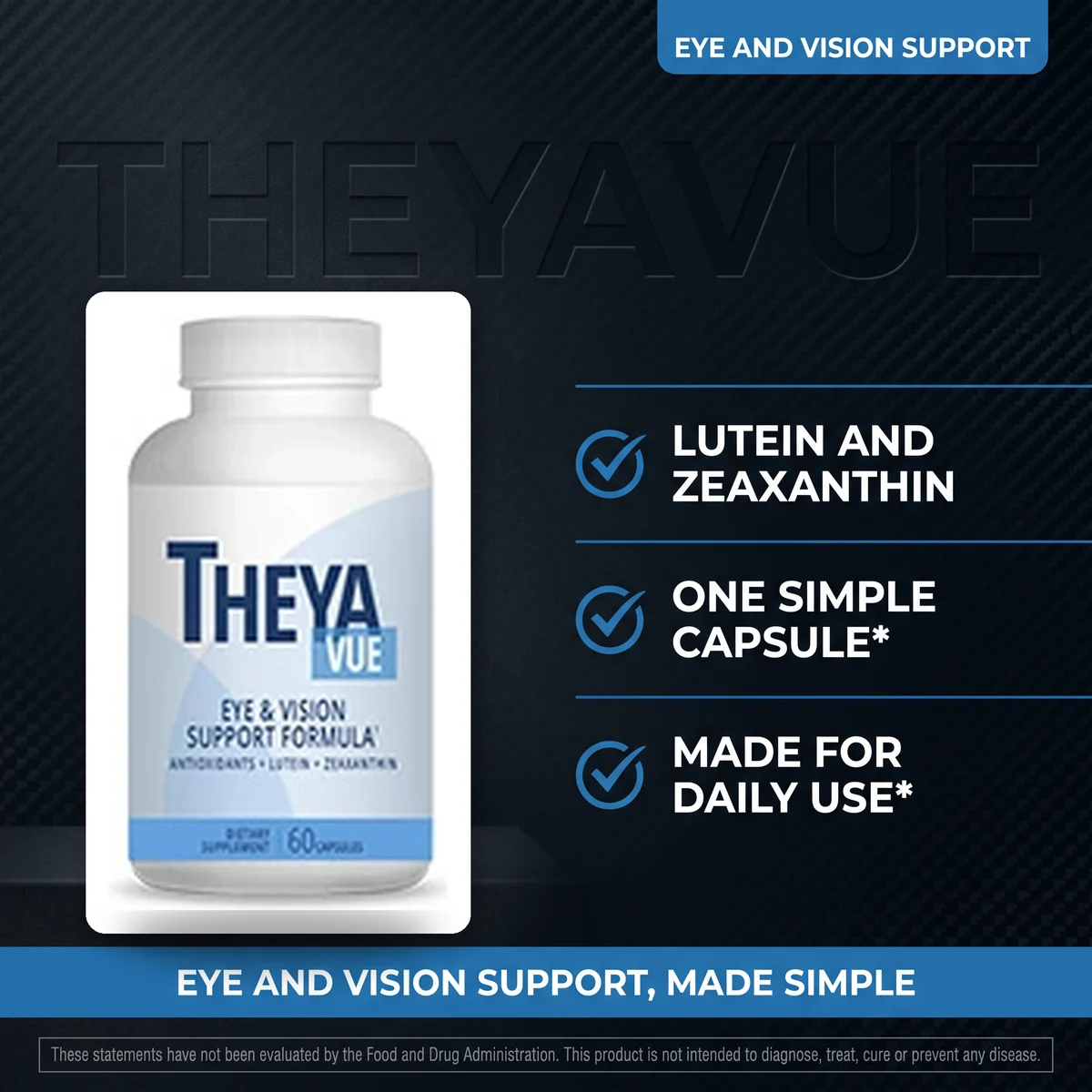
TheyaVue puts lutein, zeaxanthin, bilberry and a 20+ vitamin, mineral and botanical complex into one small vegetable capsule, made in a GMP-certified, FDA-registered US facility — and it is backed by a 60-day money-back guarantee so you can judge the fit yourself.
See TheyaVue Packages & Pricing
Comparing value? Divide the pack price by total servings — multi-bottle packs usually win on cost per day.
Common mistakes people make when buying eye supplements
Even shoppers who mean well tend to fall into the same handful of traps. Knowing them in advance saves both money and disappointment.
Buying on the front label alone
The words "advanced eye formula" or "20/20 support" carry no regulated meaning. They are chosen to sell, not to inform. Flip every product over and let the Supplement Facts panel decide the purchase.
Assuming a bigger ingredient list is better
A label crammed with 40 ingredients can look impressive while spreading a fixed budget so thin that the important nutrients are present only in trace amounts. A focused formula with meaningful doses of the right nutrients usually beats a long list of tiny ones.
Ignoring the serving size
Two products can look identically priced until you notice one requires two or three capsules per serving. That doubles or triples your true daily cost and empties the bottle far faster. Always translate the price into cost per day.
Chasing the lowest price
An eye supplement that skimps on lutein and zeaxanthin to hit a low price is not a bargain — it is simply a cheaper way to get less of what matters. Value means the most useful nutrition per dollar, not the smallest number on the shelf.
Forgetting it is a long-term habit
Macular carotenoids build up gradually, so an eye supplement is something you take steadily over months, not a quick fix. Factor in whether you will realistically keep taking it — the form, the taste, the capsule count and the reorder convenience all matter for consistency.
Your 60-second eye-supplement checklist
- ✓ Lutein and zeaxanthin both listed with real milligram amounts
- ✓ A sensible supporting cast: vitamins C and E, zinc, copper, helpful botanicals
- ✓ No hidden proprietary blend disguising the key doses
- ✓ GMP-certified, FDA-registered manufacturing with a clear origin
- ✓ Reasonable cost per serving, not just a low sticker price
- ✓ A real money-back guarantee
- ✓ Honest, wellness-focused claims — no disease cures
Frequently asked questions
What should I look for first in an eye health supplement?
Start with the Supplement Facts panel, not the front of the box. Check that lutein and zeaxanthin are listed with real milligram amounts, look for a sensible surrounding set of nutrients like vitamins C and E, zinc and copper, and confirm the serving size and servings per container so you know the true daily cost.
How much lutein and zeaxanthin should an eye supplement contain?
Much of the research on macular carotenoids used around 10 mg of lutein and 2 mg of zeaxanthin per day. Amounts near this range, listed clearly on the label, are a reasonable benchmark when you are comparing products.
Are proprietary blends a red flag?
Not always, but they hide individual amounts. If a product lists a single "proprietary eye blend" total without breaking out how much lutein or zeaxanthin it contains, you cannot compare it fairly. Prefer labels that state each key ingredient's amount.
Does third-party testing matter?
Yes. Manufacturing in a GMP-certified, FDA-registered facility and any third-party testing are good signs that what is on the label matches what is in the capsule. They speak to quality and consistency rather than to any health claim.
Is a more expensive eye supplement always better?
No. Price should be judged per serving and against the actual amounts of key nutrients delivered. A mid-priced formula that clearly lists meaningful doses of lutein, zeaxanthin and supporting nutrients can be better value than a pricier product with vague amounts.
References
- National Eye Institute. “Age-Related Eye Disease Study 2 (AREDS2).” nei.nih.gov
- U.S. Food & Drug Administration. “Dietary Supplements — What You Need to Know.” fda.gov
- National Institutes of Health, Office of Dietary Supplements. “Dietary Supplement Label Database.” ods.od.nih.gov
- American Academy of Ophthalmology. “Diet and Nutrition: Eating Right for Your Eyes.” aao.org
† These statements have not been evaluated by the Food and Drug Administration. This product is not intended to diagnose, treat, cure or prevent any disease. This article is for general educational information only and is not medical advice. Always consult a qualified eye-care professional or physician about your individual needs.