Eye Vitamin Capsules vs Gummies: Which Supplement Form Is Best?
| Capsules | Fit more actives (including fat-soluble lutein & zeaxanthin) per serving, no added sugar, more shelf-stable. |
| Gummies | Tastier and easier to take, but usually lower potency, added sugar, and less stable over time. |
| Best all-round for eyes | For a daily eye vitamin with real carotenoid amounts, a capsule is usually the stronger choice. |
| When gummies win | If you truly cannot swallow pills, a gummy you take daily beats a capsule you skip. |
Why the format matters more than you'd think
When people compare eye vitamins, they focus almost entirely on the ingredients — and that is right. But there is a second decision hiding in plain sight: the form the supplement comes in. Capsule or gummy? It sounds like a matter of taste, and partly it is. Yet the delivery format quietly shapes how much of each nutrient you can actually get, how much sugar you swallow along with it, and how reliably the product survives on your shelf. For an eye vitamin built around fat-soluble carotenoids, those differences are not trivial.
This guide compares capsules and gummies across the factors that actually matter for a daily eye supplement, so you can pick the form that fits both your goals and your habits.
Round 1: How much active ingredient fits
This is the biggest practical difference. A capsule is essentially a compact container for concentrated actives, so it can carry a lot of nutrients in a small space — including meaningful amounts of lutein, zeaxanthin and a broader vitamin and mineral complex. A gummy, by contrast, has to devote most of its bulk to the base (gelatin or pectin), sweeteners and flavour. That leaves far less room for active ingredients.
The result is that gummy formulas often contain fewer nutrients, or lower amounts of them, than an equivalent capsule. For an eye vitamin where you specifically want a real dose of lutein and zeaxanthin — the carotenoids we compare in our lutein vs zeaxanthin guide — that space constraint can be the deciding factor. Winner: capsules.
Round 2: Sugar and added ingredients
Gummies taste good for a reason: sugar, or sugar alcohols, plus flavourings and colours. A single gummy's sugar may look small, but an eye vitamin is something you take every day, indefinitely. Over months and years, that daily sugar adds up in a way a sugar-free capsule simply avoids. Capsules generally skip the sweeteners entirely, which is why many people who take a supplement long term gravitate toward them. Winner: capsules.
Round 3: Potency and shelf stability
Gummies are more exposed to heat, air and moisture than a sealed capsule, and those conditions can gradually degrade certain nutrients. To compensate, some gummy makers add nutrient overages at the time of manufacture — meaning the amount can drift over the product's life. Capsules, being drier and better sealed, tend to protect their contents more consistently. For fat-soluble carotenoids like lutein and zeaxanthin, which benefit from a stable carrier, the capsule again has the edge. Winner: capsules.
Round 4: Taste, ease and the swallowing question
Here is where gummies earn their place. They taste pleasant, require no water, and feel more like a treat than a chore — and for anyone who genuinely struggles to swallow pills, that is a real advantage, not a minor one. The best supplement is the one you actually take every day. If a capsule ends up sitting in the cupboard because swallowing it is unpleasant, while a gummy gets taken consistently, the gummy is doing more for you. Winner: gummies — for taste, convenience and swallowing ease.
Side-by-side scorecard
What about softgels, tablets and liquids?
Capsules and gummies get the most attention, but they are not the only formats on the shelf. It helps to know where the others sit so the comparison is complete.
Softgels
Softgels are a close cousin of capsules and are especially well suited to oil-based nutrients. Because fat-soluble carotenoids like lutein and zeaxanthin travel well in an oil base, some eye formulas use softgels for exactly that reason. They are easy to swallow and stable, though they usually cannot carry dry, bulky ingredients as flexibly as a two-piece capsule.
Tablets
Tablets are compact and inexpensive to produce, and they can pack in a lot of material. The trade-offs are that they sometimes use more binders and coatings to hold their shape, and larger tablets can be harder to swallow. Disintegration — how readily the tablet breaks down — varies more between products, so quality matters.
Liquids and powders
Liquids and powders are the easiest formats for anyone who dislikes swallowing anything, and they allow flexible dosing. The downsides are shorter shelf stability once opened, the frequent need for flavouring or sweetening, and the fuss of measuring a dose accurately each day.
For a daily eye vitamin specifically, capsules and softgels tend to be the most practical carriers for the fat-soluble carotenoids at the heart of the formula — which is why they dominate the category.
So which should you choose?
For a daily eye vitamin, the balance tips toward capsules in most cases. They fit more of the nutrients you actually want, skip the daily sugar, stay more stable over time, and are a better carrier for the fat-soluble carotenoids at the heart of any eye formula. If your priority is getting real amounts of lutein and zeaxanthin in a lean daily serving, a capsule is usually the stronger tool for the job.
The honest exception is swallowing. If capsules are genuinely difficult for you, do not force it — a quality gummy you take every single day will serve your eyes better than a capsule you abandon. Consistency is the nutrient that never shows up on a label but matters most, a point we return to in our guide to supporting eye health naturally.
Whichever form you lean toward, still judge the product on its contents. Our buyer's guide to choosing an eye health supplement walks through reading the label so you are not swayed by format alone.
One small capsule, once a day
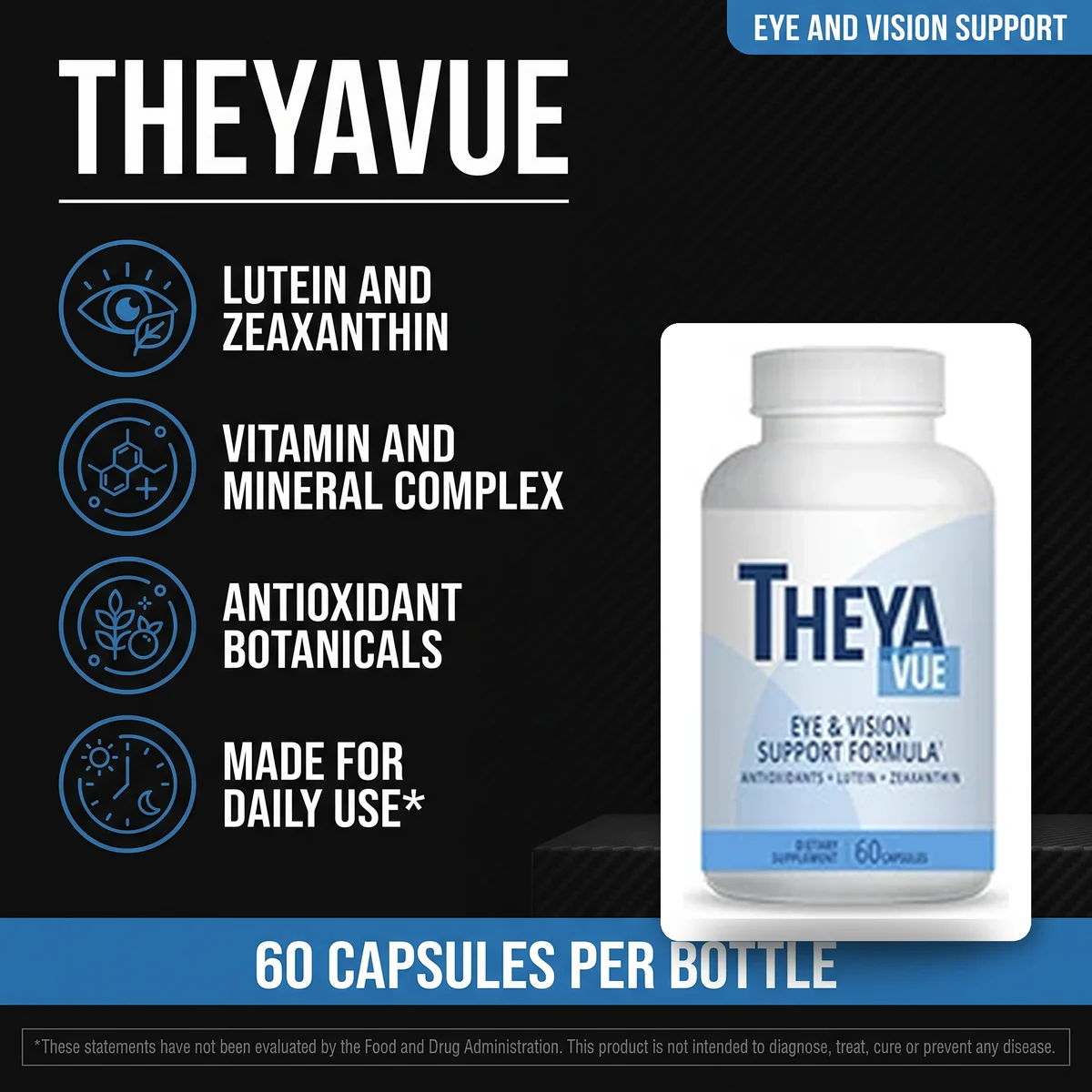
TheyaVue is a small once-daily vegetable capsule — a format that lets it carry lutein, zeaxanthin, bilberry and a 20+ vitamin, mineral and botanical complex with no added sugar, while keeping the fat-soluble carotenoids stable. Backed by a 60-day money-back guarantee.
See TheyaVue Packages
Taking a capsule daily? Multi-bottle packs keep you stocked and lower the cost per day.
The bottom line
Eye vitamin capsules vs gummies comes down to a trade-off between substance and taste. Capsules win on the things that make an eye vitamin worth taking — more actives per serving, no added sugar, better stability and a friendlier home for fat-soluble carotenoids. Gummies win on enjoyment and ease, which genuinely matters if swallowing pills is hard for you. Choose the form you will take consistently, then make sure the label backs it up with real amounts of lutein, zeaxanthin and the supporting nutrients your eyes rely on.
Frequently asked questions
Are gummy eye vitamins as effective as capsules?
It depends on what is inside. Gummies can be pleasant and easy to take, but they usually hold fewer active ingredients per piece and often add sugar. Capsules generally fit more nutrients — including fat-soluble carotenoids like lutein and zeaxanthin — into a smaller serving without added sweeteners.
Do gummy vitamins contain sugar?
Most do. To taste good, gummies typically include sugars or sugar alcohols along with gelatin or pectin. If you take an eye vitamin daily and long term, that added sugar adds up, which is one reason many people prefer capsules for everyday use.
Which form is more stable and potent over time?
Capsules tend to be more shelf-stable and can protect certain nutrients better. Gummies are exposed to heat, air and moisture more easily, which can affect potency and lead to nutrient overages at manufacture to compensate. For fat-soluble carotenoids, a capsule is often the more reliable carrier.
Are gummies better if I struggle to swallow pills?
Yes — that is the clearest case for gummies. If swallowing capsules is genuinely difficult, a well-formulated gummy you will actually take every day beats a capsule you skip. Consistency matters more than the delivery format on its own.
What form is TheyaVue?
TheyaVue is a small once-daily vegetable capsule. That format lets it carry lutein, zeaxanthin, bilberry and a 20+ vitamin, mineral and botanical complex without added sugar, and helps keep the fat-soluble carotenoids stable.
References
- U.S. Food & Drug Administration. “Dietary Supplements.” fda.gov
- National Institutes of Health, Office of Dietary Supplements. “Dietary Supplements: What You Need to Know.” ods.od.nih.gov
- Harvard T.H. Chan School of Public Health. “The Nutrition Source: Added Sugar.” hsph.harvard.edu
- American Optometric Association. “Diet and Nutrition.” aoa.org
† These statements have not been evaluated by the Food and Drug Administration. This product is not intended to diagnose, treat, cure or prevent any disease. This article is for general educational information only and is not medical advice. Always consult a qualified eye-care professional or physician about your individual needs.